

How the largest river restoration project in our nation’s history came undone
[When Congress failed to approve the Klamath Agreements this month, it effectively killed the broadly supported and locally developed package of three separate but coordinated settlement agreements. The agreements, hammered out by tribes, ranchers, government agencies, the owner of the dams (PacifiCorp) and environmental groups, would have triggered the largest river restoration project in our nation’s history, an unprecedented removal of four hydroelectric dams. What next? Stakeholders remain committed to finding a solution to water sharing, habitat restoration and dam removal. But lack of congressional approval will likely force parties to the courts. PacifiCorp will be required to reengage in the FERC dam relicensing process, which could still lead to dam removal. But it’s also possible that FERC may relicense the dams. Here, writer Frank Eldredge chronicles the Klamath Agreements and the stalemate that led to their unravelling.]
The Klamath River begins in southern Oregon where snowmelt from the Cascades feeds rivers that form Upper Klamath Lake, and from there the river carves its path through the rugged Siskiyou Mountains in northern California before emptying into the Pacific Ocean at the town of Requa. In its prime, the Klamath River was one of the top three salmon rivers on the West Coast (along with the Columbia and the Sacramento), supporting up to a million spawning adults a year. But the mighty Klamath has been dealt many grievous blows over the past century and a half from the effects of gold mining, lumber harvesting, water diversions for farming and ranching, and the building of dams. All of these impacts have cumulatively taken a heavy toll on the native fish: coho and fall chinook salmon numbers have dropped to roughly 10 percent of their historic numbers.
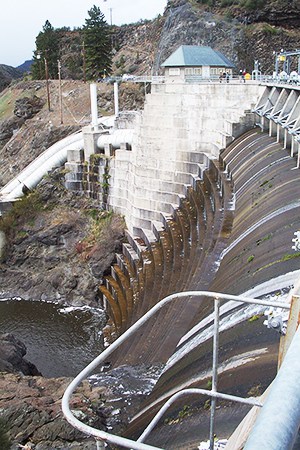
 The agreements worked out by local communities represented an historic opportunity to reverse this decline and ensure a sustainable and healthy future for the Klamath River and the people who depend on its waters. If the four Klamath dams would have been removed in 2020 per the agreements, salmon and steelhead would have gained access to more than 300 miles of additional spawning habitat and colder water in upper basin tributaries that have been closed off to them for nearly a century.
To better understand what’s at stake, it is useful to briefly review the Klamath Basin agreements.
A Brief History of the Klamath Basin Agreements
In broad terms, the history of the Klamath agreements can be grouped into three phases:
1) 2000 to 2006: negotiations regarding the mandatory relicensing of the four dams on the upper Klamath River as required by the Federal Energy Regulatory Commission (FERC), which concluded with key parties agreeing that removal of the dams was the best solution.
2) 2006 to 2010: the negotiations and signing of two comprehensive agreements covering the Klamath River Basin and dam removal, which were supported by a broad and diverse coalition of over 40 stakeholders (including CalTrout).
3) 2010 to the present: the Klamath agreements were further expanded to include a negotiated agreement between Upper Basin ranchers and the Klamath Tribes, making the settlement package even more comprehensive; the agreements sent to Congress for approval and funding, where they have been stuck for the last five years.
The Dam Relicensing Negotiations (2000 to 2006)
The key issue that needed to be resolved in the FERC relicensing negotiations was how PacifiCorp, which owns all four dams, would address the requirement of the Federal Power Act to allow salmon to migrate and spawn above its dams. PacifiCorp’s opening gambit was to propose a “trap and haul” solution to transport salmon around the dams in order to avoid the high cost of building fish ladders. CalTrout played a key role in these discussions and joined others in pushing hard for a solution that allowed for natural salmon passage, either via fish ladders or dam removal. PacifiCorp initially explored building fish ladders, but that solution turned out to be very expensive. CalTrout and partners contributed studies and other evidence in favor of removing the dams, and after running the numbers PacifiCorp came to the conclusion that the most economical solution for its ratepayers was to remove the dams. A subsequent Environmental Impact Statement/Environmental Impact Report (EIS/EIR) done by the Department of the Interior validated that dam removal was the best way to restore the upper river habitat and fisheries.
 The Settlement Agreements (2006 to 2010)
Overcoming years of arguments and animosity, the key players in the Klamath Basin finally realized that it was time to try to work together and see if they could find common ground. What emerged from these years of discussions and negotiations were two major agreements:
1) The Klamath Basin Restoration Agreement (KBRA), which established predictable water allocations for ranchers, farmers, fish, and wildlife refuges, and also identified restoration projects throughout the basin. The KBRA was signed by the Secretary of the Interior, the governors of California and Oregon, and 41 stakeholders in 2010.
2) The Klamath Hydroelectric Settlement Agreement (KHSA), which detailed the plans to remove the four dams owned and operated by PacifiCorp. PacifiCorp would contribute the first $200 million toward the cost of the dam removals, most of which has already been collected through surcharges to its ratepayers. Any costs above that level would be covered by the State of California using funds from the Water Bond that was passed in 2014. The total estimated cost of the dam removals is around $300 million. The KHSA was also signed in 2010 by KBRA parties plus PacifiCorp.
3) A third agreement, the Upper Klamath Basin Comprehensive Agreement, was added in 2014 to resolve water disputes between ranchers and the Klamath Tribe in the upper watershed.
Years of Congressional Inaction (2010 to 2015)
The Agreements stipulated that Congress must pass a bill by December 31, 2015 authorizing the agreements. Congressional involvement is required to address a variety of issues such as funding for the KBRA restoration projects (with a price tag of $466 million), changes to how the Bureau of Reclamation operates the Klamath irrigation project, a transfer of land to Indian tribes, and federal assumption of liability if any property damage occurs as a result of removing the dams.
Finally, in January of 2015, Senator Ron Wyden (D-Oregon) packaged the three Klamath agreements into one bill called The Klamath Water Recovery and Economic Restoration Act (S. 133). With the Senate bill in motion, all eyes turned to Congressman Walden (R-OR) and Congressman LaMalfa (R-CA) whose districts encompass the dams and the majority of the agricultural interests in the basin, looking for a companion bill to be introduced in the House of Representatives.
 The Causes of the Stalemate
One of the primary hurdles in the Republican-led house was that certain Republican lawmakers, several of whom sit on key committees that oversee the Klamath Basin legislation, are ideologically opposed to dam removal and are fearful of the precedent it would set. The dictum “dam removal anywhere leads to dam removal everywhere” resonates with them. Republicans representing the Klamath Basin are heavily influenced by a vocal subset of their constituents who are fiercely opposed to dam removal and any change to their traditional way of life. Resistance is particularly vehement in Siskiyou County, home of “The State of Jefferson,” where any attempt by the federal or state government to meddle in local affairs is viewed with suspicion.
Lost in the rhetoric are the basic facts of the four dams: they are privately owned and operated by a corporation that wants to remove them, in contrast to the federally-owned dams on the Snake and Columbia Rivers; they provide no water for irrigation and only negligible hydroelectric power; and the cost of their removal would not be borne by taxpayers. Also lost in the rhetoric was the degree to which these are ground-up, local solutions—hardly an example of the federal government imposing its will on a community.
If the agreements expire, PacifiCorp would be forced to resume the FERC relicensing process and might end up building fish ladders or removing the dams on its own, in either case passing on the higher costs to its ratepayers. Meanwhile, local tribes will be able to exercise their senior “time immemorial” water rights whenever they deem it necessary to protect salmon runs. As Doug LaMalfa, a Republican Congressman from California whose district includes some of the Klamath Basin, acknowledged at a town hall meeting in September, “We know the tribes can make a call on all water and shut everything down (for farmers).”
Without the agreements, the Klamath Basin could devolve to the status quo ante: communities divided by conflict and mistrust, with a return to lawsuits and battles that will only intensify as climate change inevitably reduces the amount of water in the drainage.
The Last-Ditch Effort
There remained a glimmer of hope as the calendar turned to December. Representative Greg Walden (R-Oregon), who is opposed to dam removal, released a draft bill in the House in early December that would take dam removal out of the equation and thereby make the bill more palatable to his Republican peers. Walden’s bill would preserve the broader restoration goals of the KBRA and turn the dam removal process over to FERC.
However, Walden’s approach quickly drew harsh criticism from the Senate, the Obama Administration and settlement parties because the House bill disrupted the bargained-for benefits and careful balance negotiated over many years.
“Unfortunately, Congressman Walden’s draft conspicuously leaves out the dam removal that’s vital to river restoration—the centerpiece of the whole agreement for my constituents in California—and adds poison pills in the form of massive giveaways of public lands that were never part of the settlement,” California 2nd District Congressman Jared Huffman said in a statement.
And in the end, Congressman Walden’s poison pill bill never was reconciled with the Senate bill. With the KBRA expiring on December 31, and the KHSA to expire in early 2016, it’s hard to see how Congress can salvage the delicate balance that was reached through the three negotiated agreements. The hard-won comprehensive solution that would have not only removed dams but also improved riparian conditions throughout the watershed is unlikely to be preserved in full. A failure to act by several key congressmen has sent a severe setback to the Klamath Basin. The documentary A River Between Us, by Jason Atkinson, poses this timely and relevant question at the conclusion of the film: “Are we big enough to finish the largest restoration project in American history?”
The answer for now is no. At least for now.
[This article originally appeared in The Current. Photos courtesy of CalTrout.]

Tom Bie is the founder, editor, and publisher of The Drake. He started the magazine in 1998 as an annual newsprint publication based in Jackson Hole, Wyoming. He then moved it to Steamboat, Colorado (1999), Boulder, Colorado (2001), and San Clemente, California (2004), as he took jobs as managing editor at Paddler, Senior Editor at Skiing, and Editor-in-Chief at Powder, respectively. Tom and The Drake are now both based in Denver, Colorado, where The Drake is finally all grows up(Swingers, 1996) to a quarterly magazine.