

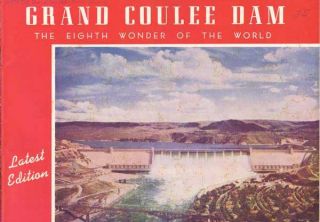
Washington’s Grand Coulee Dam on the upper Columbia River, located about two hours north of Spokane, was completed in 1942. Today, the energy-producing colossus remains one of the mightiest of its kind in the country.
Beyond generating juice, the erection of a 550-foot tall wall across the Pacific Northwest’s largest river came with consequences.
The dam created Lake Roosevelt. The 80,000-acre impoundment forced the relocation of more than 3,000 people, including Native Americans whose ancestral lands were effectively doused and drowned. And it also severed the migration highway for industrious runs of salmon and steelhead charging upstream to spawn.
This month, the Northwest Power & Conservation Council—tasked with the paradoxical challenges of integrating energy and the environment in the Columbia River Basin—took the first step in providing passage for those lost fish.
Bonneville Power Administration (BPA) and the council are currently seeking proposals to investigate whether more than 500 miles of tribs and mainstem river from Grand Coulee Dam to the Canadian border have suitable habitat to support reintroduced chinook and sockeye salmon, and steelhead.
 According to the Columbia Basin Bulletin, investigating blocked-area mitigation through reintroduction, passage, and habitat improvement upstream of dams without fish passage is one of the council’s emerging priorities that it hopes to fund through cost-savings in BPA programs.
Feasibility Afoul
Early estimates say the study could cost as much as $200,000.
Tony Grover, a council staffer, told council members at their monthly meeting in Vancouver, WA that he expects a coalition of partners would likely win the bid. The coalition could include many of the upper Columbia River tribes along with the Salmon Recovery Board and other federal agencies, such as the U.S. Fish & Wildlife Service.
Council members approved the measure unanimously, but some warned that they were only voting to fund a study of the habitat above Grand Coulee Dam—and not approving measures that would reintroduce anadromous fish.
“I’ll support this, but I don’t believe that upriver passage is even feasible,” said Idaho council member Bill Booth. “Nor can it be done while maintaining the integrity of Grand Coulee, which is the heart of the FCRPS [Federal Columbia River Power System].”
The study is slated for completion in 2017.

Tom Bie is the founder, editor, and publisher of The Drake. He started the magazine in 1998 as an annual newsprint publication based in Jackson Hole, Wyoming. He then moved it to Steamboat, Colorado (1999), Boulder, Colorado (2001), and San Clemente, California (2004), as he took jobs as managing editor at Paddler, Senior Editor at Skiing, and Editor-in-Chief at Powder, respectively. Tom and The Drake are now both based in Denver, Colorado, where The Drake is finally all grows up(Swingers, 1996) to a quarterly magazine.
- Tom Bie
- Tom Bie
- Tom Bie
- Tom Bie
- Tom Bie
- Tom Bie
- Tom Bie
- Tom Bie
- Tom Bie
- Tom Bie
- Tom Bie
- Tom Bie
- Tom Bie
- Tom Bie
- Tom Bie
- Tom Bie
- Tom Bie
- Tom Bie
- Tom Bie
- Tom Bie
- Tom Bie
- Tom Bie
- Tom Bie
- Tom Bie
- Tom Bie
- Tom Bie
- Tom Bie
- Tom Bie
- Tom Bie
- Tom Bie
- Tom Bie
- Tom Bie
- Tom Bie
- Tom Bie
- Tom Bie
- Tom Bie
- Tom Bie
- Tom Bie
- Tom Bie
- Tom Bie
- Tom Bie
- Tom Bie
- Tom Bie
- Tom Bie
- Tom Bie
- Tom Bie
- Tom Bie
- Tom Bie
- Tom Bie
- Tom Bie
- Tom Bie
- Tom Bie
- Tom Bie
- Tom Bie
- Tom Bie
- Tom Bie
- Tom Bie
- Tom Bie
- Tom Bie
- Tom Bie
- Tom Bie
- Tom Bie
- Tom Bie
- Tom Bie
- Tom Bie
- Tom Bie
- Tom Bie
- Tom Bie
- Tom Bie
- Tom Bie
- Tom Bie
- Tom Bie
- Tom Bie
- Tom Bie
- Tom Bie
- Tom Bie
- Tom Bie
- Tom Bie
- Tom Bie
- Tom Bie
- Tom Bie
- Tom Bie
- Tom Bie
- Tom Bie
- Tom Bie
- Tom Bie
- Tom Bie
- Tom Bie
- Tom Bie
- Tom Bie
- Tom Bie
- Tom Bie
- Tom Bie
- Tom Bie
- Tom Bie
- Tom Bie
- Tom Bie
- Tom Bie
- Tom Bie
- Tom Bie
- Tom Bie
- Tom Bie
- Tom Bie
- Tom Bie
- Tom Bie
- Tom Bie
- Tom Bie
- Tom Bie
- Tom Bie
- Tom Bie
- Tom Bie
- Tom Bie
- Tom Bie
- Tom Bie
- Tom Bie
- Tom Bie
- Tom Bie
- Tom Bie
- Tom Bie
- Tom Bie
- Tom Bie
- Tom Bie
- Tom Bie
- Tom Bie
- Tom Bie
- Tom Bie
- Tom Bie
- Tom Bie
- Tom Bie
- Tom Bie
- Tom Bie
- Tom Bie
- Tom Bie
- Tom Bie
- Tom Bie
- Tom Bie
- Tom Bie
- Tom Bie
- Tom Bie
- Tom Bie
- Tom Bie
- Tom Bie
- Tom Bie
- Tom Bie
- Tom Bie
- Tom Bie
- Tom Bie
- Tom Bie
- Tom Bie
- Tom Bie
- Tom Bie
- Tom Bie
- Tom Bie
- Tom Bie
- Tom Bie
- Tom Bie
- Tom Bie
- Tom Bie
- Tom Bie
- Tom Bie
- Tom Bie
- Tom Bie
- Tom Bie
- Tom Bie
- Tom Bie
- Tom Bie
- Tom Bie
- Tom Bie
- Tom Bie
- Tom Bie
- Tom Bie
- Tom Bie
- Tom Bie
- Tom Bie
- Tom Bie
- Tom Bie
- Tom Bie
- Tom Bie
- Tom Bie
- Tom Bie
- Tom Bie
- Tom Bie
- Tom Bie
- Tom Bie
- Tom Bie
- Tom Bie
- Tom Bie
- Tom Bie
- Tom Bie
- Tom Bie
- Tom Bie
- Tom Bie
- Tom Bie
- Tom Bie
- Tom Bie
- Tom Bie
- Tom Bie
- Tom Bie
- Tom Bie
- Tom Bie
- Tom Bie
- Tom Bie
- Tom Bie
- Tom Bie
- Tom Bie
- Tom Bie
- Tom Bie
- Tom Bie
- Tom Bie
- Tom Bie
- Tom Bie
- Tom Bie
- Tom Bie
- Tom Bie
- Tom Bie
- Tom Bie
- Tom Bie
- Tom Bie
- Tom Bie
- Tom Bie
- Tom Bie
- Tom Bie
- Tom Bie
- Tom Bie
- Tom Bie
- Tom Bie
- Tom Bie
- Tom Bie
- Tom Bie
- Tom Bie
- Tom Bie
- Tom Bie
- Tom Bie
- Tom Bie
- Tom Bie
- Tom Bie
- Tom Bie
- Tom Bie
- Tom Bie
- Tom Bie
- Tom Bie
- Tom Bie
- Tom Bie
- Tom Bie
- Tom Bie
- Tom Bie
- Tom Bie
- Tom Bie
- Tom Bie
- Tom Bie
- Tom Bie
- Tom Bie
- Tom Bie
- Tom Bie
- Tom Bie
- Tom Bie
- Tom Bie
- Tom Bie
- Tom Bie
- Tom Bie
- Tom Bie
- Tom Bie
- Tom Bie
- Tom Bie
- Tom Bie
- Tom Bie
- Tom Bie
- Tom Bie
- Tom Bie
- Tom Bie
- Tom Bie
- Tom Bie
- Tom Bie
- Tom Bie
- Tom Bie
- Tom Bie
- Tom Bie
- Tom Bie
- Tom Bie
- Tom Bie
- Tom Bie
- Tom Bie
- Tom Bie
- Tom Bie
- Tom Bie
- Tom Bie
- Tom Bie
- Tom Bie
- Tom Bie
- Tom Bie
- Tom Bie
- Tom Bie
- Tom Bie
- Tom Bie
- Tom Bie
- Tom Bie
- Tom Bie
- Tom Bie
- Tom Bie
- Tom Bie
- Tom Bie
- Tom Bie
- Tom Bie
- Tom Bie
- Tom Bie
- Tom Bie
- Tom Bie
- Tom Bie
- Tom Bie
- Tom Bie
- Tom Bie
- Tom Bie
- Tom Bie
- Tom Bie
- Tom Bie
- Tom Bie
- Tom Bie
- Tom Bie
- Tom Bie
- Tom Bie
- Tom Bie
- Tom Bie
- Tom Bie
- Tom Bie
- Tom Bie
- Tom Bie
- Tom Bie
- Tom Bie
- Tom Bie
- Tom Bie
- Tom Bie
- Tom Bie
- Tom Bie
- Tom Bie
- Tom Bie
- Tom Bie
- Tom Bie
- Tom Bie
- Tom Bie
- Tom Bie
- Tom Bie
- Tom Bie
- Tom Bie
- Tom Bie
- Tom Bie
- Tom Bie
- Tom Bie
- Tom Bie
- Tom Bie
- Tom Bie
- Tom Bie
- Tom Bie
- Tom Bie
- Tom Bie
- Tom Bie
- Tom Bie
- Tom Bie
- Tom Bie
- Tom Bie
- Tom Bie
- Tom Bie
- Tom Bie
- Tom Bie
- Tom Bie
- Tom Bie
- Tom Bie
- Tom Bie
- Tom Bie
- Tom Bie
- Tom Bie
- Tom Bie
- Tom Bie
- Tom Bie
- Tom Bie
- Tom Bie
- Tom Bie
- Tom Bie
- Tom Bie
- Tom Bie
- Tom Bie
- Tom Bie
- Tom Bie
- Tom Bie
- Tom Bie
- Tom Bie
- Tom Bie
- Tom Bie
- Tom Bie
- Tom Bie
- Tom Bie
- Tom Bie
- Tom Bie
- Tom Bie
- Tom Bie
- Tom Bie
- Tom Bie
- Tom Bie
- Tom Bie
- Tom Bie
- Tom Bie
- Tom Bie
- Tom Bie
- Tom Bie
- Tom Bie
- Tom Bie
- Tom Bie
- Tom Bie
- Tom Bie
- Tom Bie
- Tom Bie
- Tom Bie
- Tom Bie
- Tom Bie
- Tom Bie
- Tom Bie
- Tom Bie
- Tom Bie
- Tom Bie
- Tom Bie
- Tom Bie
- Tom Bie
- Tom Bie
- Tom Bie
- Tom Bie
- Tom Bie
- Tom Bie
- Tom Bie
- Tom Bie
- Tom Bie
- Tom Bie
- Tom Bie
- Tom Bie
- Tom Bie
- Tom Bie
- Tom Bie
- Tom Bie
- Tom Bie
- Tom Bie
- Tom Bie
- Tom Bie
- Tom Bie
- Tom Bie
- Tom Bie
- Tom Bie
- Tom Bie
- Tom Bie
- Tom Bie
- Tom Bie
- Tom Bie
- Tom Bie
- Tom Bie
- Tom Bie
- Tom Bie
- Tom Bie
- Tom Bie
- Tom Bie
- Tom Bie
- Tom Bie
- Tom Bie
- Tom Bie
- Tom Bie
- Tom Bie
- Tom Bie
- Tom Bie
- Tom Bie
- Tom Bie
- Tom Bie
- Tom Bie
- Tom Bie
- Tom Bie
- Tom Bie
- Tom Bie
- Tom Bie
- Tom Bie
- Tom Bie
- Tom Bie
- Tom Bie
- Tom Bie
- Tom Bie
- Tom Bie
- Tom Bie
- Tom Bie
- Tom Bie
- Tom Bie
- Tom Bie
- Tom Bie
- Tom Bie
- Tom Bie
- Tom Bie
- Tom Bie
- Tom Bie
- Tom Bie
- Tom Bie
- Tom Bie
- Tom Bie
- Tom Bie
- Tom Bie
- Tom Bie
- Tom Bie
- Tom Bie
- Tom Bie
- Tom Bie
- Tom Bie
- Tom Bie
- Tom Bie
- Tom Bie
- Tom Bie
- Tom Bie
- Tom Bie
- Tom Bie
- Tom Bie
- Tom Bie
- Tom Bie
- Tom Bie
- Tom Bie
- Tom Bie
- Tom Bie
- Tom Bie
- Tom Bie
- Tom Bie
- Tom Bie
- Tom Bie
- Tom Bie
- Tom Bie
- Tom Bie
- Tom Bie
- Tom Bie
- Tom Bie
- Tom Bie
- Tom Bie
- Tom Bie
- Tom Bie
- Tom Bie
- Tom Bie
- Tom Bie
- Tom Bie
- Tom Bie
- Tom Bie
- Tom Bie
- Tom Bie
- Tom Bie
- Tom Bie
- Tom Bie
- Tom Bie
- Tom Bie
- Tom Bie
- Tom Bie
- Tom Bie
- Tom Bie
- Tom Bie
- Tom Bie
- Tom Bie
- Tom Bie
- Tom Bie
- Tom Bie
- Tom Bie
- Tom Bie
- Tom Bie
- Tom Bie
- Tom Bie
- Tom Bie
- Tom Bie
- Tom Bie
- Tom Bie
- Tom Bie
- Tom Bie
- Tom Bie
- Tom Bie
- Tom Bie
- Tom Bie
- Tom Bie
- Tom Bie
- Tom Bie
- Tom Bie
- Tom Bie
- Tom Bie
- Tom Bie
- Tom Bie
- Tom Bie
- Tom Bie
- Tom Bie
- Tom Bie
- Tom Bie
- Tom Bie
- Tom Bie
- Tom Bie
- Tom Bie
- Tom Bie
- Tom Bie
- Tom Bie
- Tom Bie
- Tom Bie
- Tom Bie
- Tom Bie
- Tom Bie
- Tom Bie
- Tom Bie
- Tom Bie
- Tom Bie
- Tom Bie
- Tom Bie
- Tom Bie
- Tom Bie
- Tom Bie
- Tom Bie
- Tom Bie
- Tom Bie
- Tom Bie
- Tom Bie
- Tom Bie
- Tom Bie
- Tom Bie
- Tom Bie
- Tom Bie
- Tom Bie
- Tom Bie
- Tom Bie
- Tom Bie
- Tom Bie
- Tom Bie
- Tom Bie
- Tom Bie