

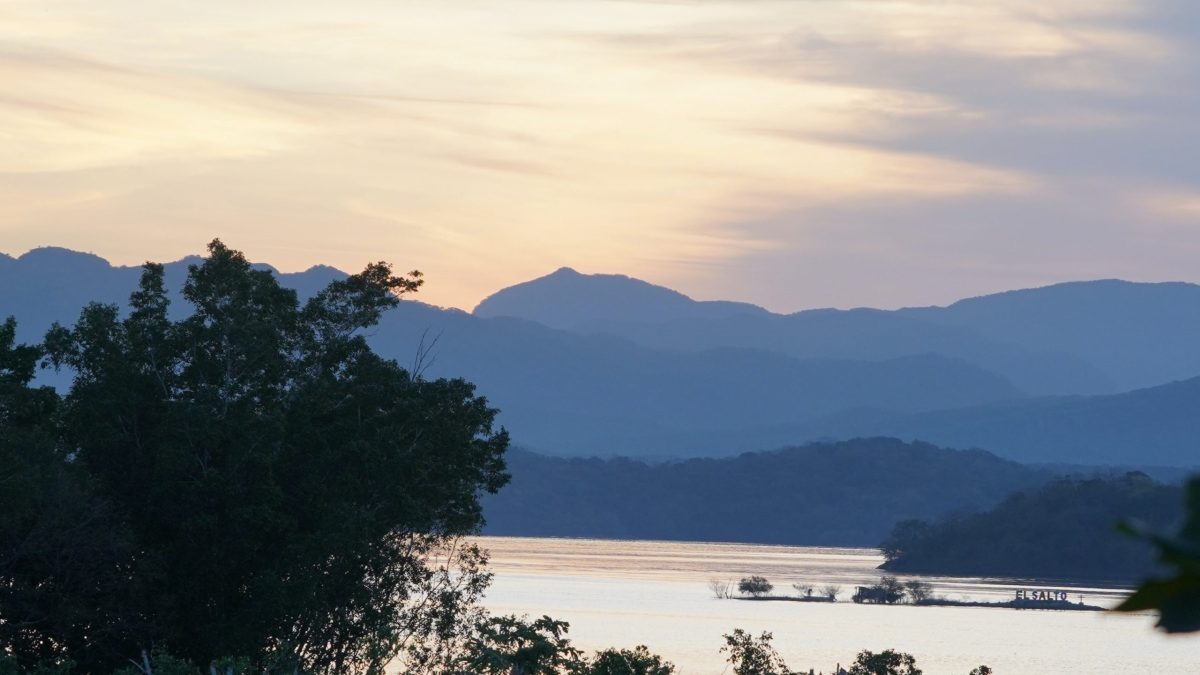
Sinaloa Largemouth
BY TOM BIE
Dan Soltau is owner of the Plano, Texas-based fly shop Dirty Water Fly Company. He also hosts fishing trips, and recently returned from hosting his sixth group at Anglers Inn, located in the Mexican state of Sinaloa. One of the many nice aspects of Anglers Inn is that it has lodges on both Lake El Salto and Lake Picachos, two of the finest largemouth lakes on earth. A typical hosted trip would see all of the guests staying together at one of the two lakes, with maybe a chance for a day trip to the other one. But this would not be a typical hosted trip.
On December 8, 2024—the first full day of fishing for the twenty-four clients that Soltau and his partner Brett Wedeking had brought to the lake—Soltau’s boat came across four young cartel members, each of them heavily armed.
“We had just started our afternoon session, fishing about thirty feet from shore, and they came out of the jungle, started talking to our guide, Diego [not his real name], and then told us to pull up to shore,” Soltau said. “They were on a remote part of the lake, in one of our favorite zones to fish.”
In cartel parlance, these groups are called “cells”—smaller units typically responsible for a particular product or geographic region. They are often made up of ex-police, ex-military, or ex-“punteros”—teenage lookouts who zip around on bikes or scooters in a city, scouting for police, feds, or rival gangs.
The men told Soltau that they wanted to look around. “So, all four dudes jump in the boat with us, armed to the teeth, and we basically made a surveillance run,” Soltau said. “It was me, Diego, one of my clients, and four of these dudes. We drove around that part of the lake for about two hours just looking at stuff—seven of us, in a twenty-foot bass boat. Diego remained cool and collected, and kept assuring us, ‘Está bien.’” (“It’s OK.”)
Lake El Salto is huge, 27,000 acres when full, similar in size to Lake Fork Reservoir east of Dallas, a largemouth factory that happens to be Soltau’s home water. But the Sierra Madre Jungle is a far easier place to get lost, and after two hours on the water, the cartel members weren’t sure they could relocate their camp.
“Their boss sent a drone up for the guys in our boat to spot, to help guide them back,” Soltau said. “When we got to their camp, which is on one of my favorite creeks on the lake, we hung out for twenty minutes just talking to them on the beach. Then they said they wanted us to get out of the boat and come up to their cabin. This was when things looked to be a bit more sketchy, because we’re out of the boat, on land, and in the middle of nowhere.”
Soltau and his fishing partner walked up to the cabin, and Soltau began talking with the boss. “He had two armed guards with him, and he had a vest on,” Soltau said. “He talked to us for a bit and then said [in Spanish], ‘You guys are good, just let us talk to your guide for a bit.’ He was like 35, my age, and he sent us back down, then talked to Diego for about twenty minutes before sending him down. Once we all got back to the boat, two of my close friends come rolling in with their guide, Mateo [not his real name], and they’d been commandeered as well. So now we have two boats, with a total of seven cartel guys on them.”
Soltau speaks Spanish, so he began talking to the men about the fishing. “I’m just telling them how famous the lake is, how big the bass are, showing them some flies, and describing the commercial tilapia netting that goes on,” Soltau said. “We were also drinking Pacificos, with the cartel guys. Then one of them says, ‘Why don’t you fish? Show us what you do.’ So we started casting from the boat. Things had de-intensified. Diego, who is the longest-standing guide at Anglers Inn, was staying calm.”
Side note: Commercial tilapia netting on Lake El Salto has been going on for decades, with some fifty to sixty fishermen typically working the lake from October to April. But this year’s tilapia fishery is eerily quiet, with most if not all netters being too worried about regional violence to work on an isolated lake.
Chasing bass on Lake El Salto wasn’t always so precarious. In July 2019, when Sinaloa Cartel leader Joaquin “El Chapo” Guzman entered federal prison in Florence, Colorado—the nation’s only Level 6 supermax—he was finally in a facility that could contain him. He’d escaped Mexican prisons twice before, once in a laundry cart and once through a mile-long tunnel dug beneath prison walls. With El Chapo gone the cartel started to splinter, and two rival factions emerged: La Mayiza, run by Ismael “El Mayo” Zambada, a co-founder of the Sinaloa Cartel; and Los Chapitos, run by El Chapo’s four sons.
This ever-shifting turf battle has made for a tense five years in Sinaloa, especially in its capital city of Culiacán. Ovidio Guzmán López, one of El Chapo’s sons, was first captured in Culiacán, in 2019, but was famously set free by cartel gunmen who overwhelmed Mexican law enforcement: “The cartel’s victory offered a frightening glimpse into the power wielded by organized crime in Mexico,” read a NY Times op-ed, “distilling in a single, eight-hour stretch the extent to which the nation is held captive by criminal networks.” (Ovidio Guzmán López is currently in U.S. custody.)
Not that Sinaloa tentacles don’t reach far beyond mainland Mexico. They’re in Baja; on the Yucatan Peninsula; in Chicago, New York, Dallas, Detroit. They’re in small ski towns and big beach towns. On December 10, 2024, seventeen people were indicted in Denver for stealing at least one hundred and ninety vehicles—mostly high-end pickups taken from the airport parking lots—and trading them to the Sinaloa Cartel for drugs.
It’s hard to track every turning point in a cartel war, but three significant events in recent months have dramatically increased the frequency and intensity of violent events in Sinaloa. The first came on July 25, when El Mayo and Juaquin Guzmán López (another son of El Chapo) were arrested by U.S. Justice Department officials at an airport in Santa Teresa, New Mexico.
What followed, in mid-August, was U.S. and Mexico officials confirming what many in Sinaloa had feared: Juaquin Guzmán López had not only betrayed El Mayo, he had abducted him, forcing him onto a plane that landed them both in U.S. custody.
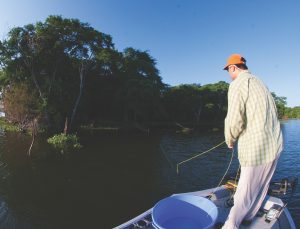
No shortage of sunken structure on El Salto. Photo by John Sherman
Then Sept. 9 happened, when a few early-morning fights on the streets of Culiacán grew into one of the most violent days the city had ever seen. La Mayiza and Los Chapitos declared war on each other; the university in Sinaloa sent its seventy thousand students home; gunmen boarded public busses; and the Mexican government dispatched army troops and National Guard units. Back on the lake, Soltau and his armed visitors had figured out that what the cartel members really needed was food for their jungle camp. They wanted to get some tilapia from nets on the lake, and they needed a guide to go with them. Soltau’s guide, Diego, had stayed fairly calm all afternoon because the men who’d boarded his boat had mostly just talked to them. But Mateo, the guide for Soltau’s two buddies in the other boat, was visibly shaken, because his boat had received a far-less-cordial reception.
“All three of their dudes came walking out of the jungle with guns pointed at them, from a hundred yards away,” Soltau said. “They held Mateo and my two friends at gunpoint for twenty-five minutes. So Mateo was terrified.”
To be clear: There’s generally no animosity toward tourists in Mexico because tourism is their number one revenue source. So, as Soltau pointed out, “As crazy as it was, once this second armed group finally believed that all of them were just fishermen, they relaxed quite a bit.” But Mateo still stayed with Soltau and the three clients while Diego took seven cartel members to get the tilapia. “They took our guide and our coolers, and loaded up the boat to go empty a bunch of tilapia nets,” Soltau said. “This took another two hours, so I was getting a little nervous. These guys had ARs, AKs, M16s, six magazines on their chest… I mean, they were ready for some pretty serious resistance.”
When they finally returned, the cartel guys said they wanted to make a second tilapia run and then get dropped off at their camp. “So the four of us get in the boat with Mateo and follow them out there,” Soltau said. “And Mateo, who was shaking, says to us, ‘You guys should be more scared.’ But we were scared, obviously. We all have kids. I have a year-and-a-half-year old baby. I mean, there was no point in being, like, terrified, but we also weren’t pulling our phones out and trying to take pictures.”
Soltau’s group kept a close eye on Diego’s boat, but at one point his boat disappeared. “We watched them come out of a cove with the tilapia and then they go around a corner and suddenly were out of site,” Soltau said. “And now it’s getting dark, so we’re nervous, and Mateo was scared because he’s been friends with Diego for twenty years. But eventually, here he comes, motoring out of that cove. He was way out there, but we could tell he had no cartel guys in the boat. It was just him.”
When Diego pulled up, Soltau and his client hopped in his boat and they all headed for the lodge. “We got back around the same time as everyone else,” Soltau said. “Six p.m., basically last light. I pull in and tell everyone, ‘Head up to the lodge, we gotta talk.’”
As his clients were coming in, Soltau explained to each of them, individually, what had happened. Then he gathered them all together. “Dinner and drinks as usual tonight,” he said, “but we’re leaving in the morning. Once I talk to the owners, I’ll have some options for us.” (A few guests drank heavily that night.)
Anglers Inn had sixteen spots available at their other lodge, on Lake Picachos, about two hours away by van. When Soltau addressed everyone as a group, he told them he would make a list of who wants to go home, and who wants to go to Lake Picachos. “Then I took comments,” Soltau said, “and one of the first comments was, ‘Can’t we just stay here, and fish close to the lodge?’ Not a single person wanted to go home.”
As shocking as these decisions may sound to some, it might be less surprising to anyone who has fished this legendary lake. “It’s the blowups,” said Soltau, referring to the particularly explosive eats of monster largemouth bass in shallow water. “That’s what makes El Salto so badass. It’s just an incredibly special venue.”
Outside of the southern U.S. and California, a good largemouth weighs about three pounds. At El Salto, a good one weighs three times that. The lake record is nearly nineteen pounds. Healthy populations of threadfin shad and tilapia, plus mandatory catch-and-release, maintains this fishery. It’s also affordable. A week at El Salto costs a fifth of what many Alaska lodges would charge.
“We had a group of twenty-four guests, and eight of us are in the [flyfishing] industry,” Soltau said. “Guides can afford to fish here. There are so many big fish, and we are fishing topwater. Like, that is basically all we’re fishing, all day. I barely even use a sink tip. We usually out-fish the gear guys because they can’t fish the shallows like we’re able to. Multiple times on past trips, we have doubled-up the conventional guys. We’ve converted a lot of them in our groups from conventional techniques to fly.”
This remarkable fishery attracts many group trips, and in late December, longtime Florida flats guide Rick Ruoff had just returned from hosting one at El Salto Lodge, owned by Pro Bass Adventures. “The safety concerns are way overblown,” said Ruoff, who hadn’t heard of the cartel’s run-in with Soltau’s group. “Yes, there was some gunfire, but I slept right through it. It was two rival factions out in the woods, not anywhere near us. It’s no big deal, and bad publicity would kill the lodge bookings. I’d be more worried about driving around Miami.”
Not everyone agrees that what’s going on in Sinaloa is “no big deal.” Ruoff’s Miami comment might be a fair assessment, but the gunshots he slept through were still frightening enough to send one of his clients home on a flight the next day.
Mexico has had more than 430,000 homicides since 2006, when its government declared war on the cartels. During the country’s 2024 election cycle, thirty-seven political candidates were assassinated. And in the six months since El Mayo was captured, more than six hundred people have been murdered in Sinaloa alone, including El Mayo associate and wanted fentanyl trafficker Leobardo García Corrales, on whom the U.S. DEA had placed a four-million-dollar bounty. Corrales’ body was found next to two other bodies on August 17, near Federal Highway 15 in the town of Elota, sixteen miles south of Lake El Salto.
On October 31, the U.S. Consulate in Hermosillo, a city just north of Sinaloa, issued this statement: “U.S. Consulate Hermosillo continues to receive reports of armed car thefts, gunfire, security forces operations, roadblocks, burning vehicles, and closed roadways in the vicinity of Culiacan in the state of Sinaloa. U.S. citizens have been victims of armed carjacking and robbery along Federal Highway 15. The U.S. Consulate General reminds U.S. citizens that Sinaloa is classified as ‘Level 4: Do Not Travel’ in the State Department’s travel advisory for Mexico.”
At 5 a.m. the morning after the big sit-down with Soltau’s group, all of the El Salto guides held a meeting. Of the fifteen guides scheduled to work that week, ten of them refused to go back out on the lake. “At first, nobody was going to go out,” Soltau said. “But a few of the older guides I’d fished with over the years were fine with guiding as long as we stayed within sight of the lodge.” So, nine of their guests stayed and fished at El Salto.
Meanwhile, Wedeking relocated with fifteen of the guests to the Anglers Inn lodge on Lake Picachos, about a two-hour drive away, which has its own guides. That group stayed there the rest of the week, and had excellent fishing.
No further cartel encounters were reported, but Anglers Inn owners Billy and Gail Chapman made the difficult decision, just two weeks after Soltau’s group left, to shut down their 2025 operations on El Salto. (They had also delayed their opening by more than a month.) Anglers Inn is offering their guests the option to reschedule for a future year; receive a full refund; or switch to fishing at Lake Picachos.
The entire Anglers Inn staff deserve thanks for sticking around after what Soltau’s crew experienced, as they were navigating unchartered waters as well.
And while no guests or employees were physically harmed, the unsettling encounters at Lake El Salto in early December were nonetheless eye-opening experiences for host Dan Soltau and his guests. When asked if he would return, Soltau gave a thoughtful answer: “The risk now is heavy, but I’ll definitely be back. I’m keeping my calendar open, but uncertainties in that region currently make almost any prediction difficult.



Tom Bie is the founder, editor, and publisher of The Drake. He started the magazine in 1998 as an annual newsprint publication based in Jackson Hole, Wyoming. He then moved it to Steamboat, Colorado (1999), Boulder, Colorado (2001), and San Clemente, California (2004), as he took jobs as managing editor at Paddler, Senior Editor at Skiing, and Editor-in-Chief at Powder, respectively. Tom and The Drake are now both based in Denver, Colorado, where The Drake is finally all grows up(Swingers, 1996) to a quarterly magazine.