


Monumental Decision
BY TOM BIE
FANS OF THE early-2000s political drama “The West Wing” may recall an episode in the show’s first season where Josh (Bradley Whitford, as Deputy Chief of Staff) tells President Bartlet (Martin Sheen) how he can use the Antiquities Act of 1906 to prevent a mine from being built in Montana: “You’re gonna establish Big Sky National Park!”
Technically, the show had it a little wrong. The Antiquities Act does not allow a president to create a National Park. But it does grant the power to designate National Monuments, which provide the strongest protections available without an Act of Congress. Former President Biden added five new national monuments, expanded two others, and restored the million or so acres to Bears Ears (established by Obama) and Grand Staircase Escalante (established by Clinton) that President Trump reduced. (The legality of reductions remains unsettled.)
Some may question the number of national monument designations but there’s no questioning which one should be next: The 2.5-million-acres of Oregon’s portion of the Owyhee Canyonlands, the largest, wildest, most isolated, and most deserving chunk of land left in the Lower 48.
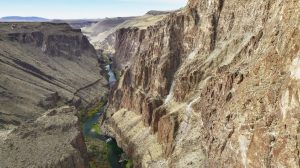
Owyhee Canyonlands
When flyfishers think of “the Owyhee,” they typically picture the brown trout-filled tailwater below Owyhee Dam, two hours west of Boise. But fisheries in Oregon’s Canyonlands go far beyond the tailwater. In 2014, five tribal governments, four federal agencies, six states, and Trout Unlimited all signed a “Rangewide Conservation Agreement” to protect the Interior Redband Trout, including the Great Basin Redband found in the Owyhees. While not officially an ESA-designated threatened or endangered species, the redband is recognized as a cherished resource, and Oregon law sets aside land for its protection.
Even the Owyhee tailwater, beautiful as it is, can’t compare to all that lies south of it: a seven-million-acre watershed with 10,000-foot peaks, Wild & Scenic Rivers, sheer-walled canyons, immense rock spires, golden eagles, sage grouse, kit foxes, chukar, elk, bighorn sheep, pronghorn antelope, a mere 300 miles of paved roads, and, for decades, few human visitors.
Not anymore. The Owyhees have been discovered, and not just by Instagrammers driving Sprinter Vans down Leslie Gulch Road. The population of Boise’s metro area has doubled over the past thirty years, to nearly a million people. The influx isn’t all Boise folks, either. Joining hunters, anglers, boaters, bikers, birders, rafters, and untold numbers of hikers and backpackers, has been a surge of unregulated recreationalists, long-term campers, developers, and gas, oil, mining and other extraction-industry types, with much of the herd being driven by an almost total absence of federal environmental protections.
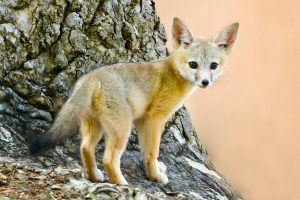
Kit Fox cuteness might be reason enough to protect the Owyhee Canyonlands. Photo By: Donald Quintana
Roughly half of the Owyhee Canyonlands are in Oregon, with the other half being almost equally divided between Idaho and Nevada. They are part of the traditional ancestral lands of the Northern Paiute, Bannock, and Shoshone tribes. Campaigns to protect them have taken place for decades, but few have been successful in Southeast Oregon. In spring of 2009, Congress added more than half a million acres of adjacent wilderness to Idaho’s Owyhee region, including the Owyhee River Wilderness, North Fork Owyhee Wilderness, and Pole Creek Wilderness. The 806 federally managed wilderness areas in the U.S. provide stronger protections than even national parks or monuments.
Going the congressional route via the National Wilderness Preservation System is one way to gain protections, and Oregon Senators Ron Wyden and Jeff Merkley have been trying this alternative since 2019, when they first introduced the Malheur Community Empowerment for the Owyhee Act (S.1890).
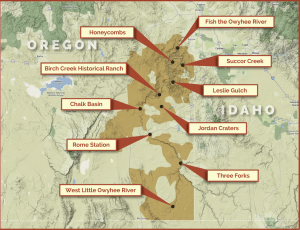
Owyhee Map
The bill would designate the most pristine parts of the canyonlands in Oregon—1.1 million acres—as wilderness areas, and would form a management group to help oversee the region’s natural resources. It would also convey about thirty thousand acres to the Burns Paiute Tribe, and would grandfather in the flexible grazing, hunting, and other multiple-use rights that many locals fear losing. The bill has been introduced three times since 2019, but, as you may know, Congress isn’t functioning so well lately.
Consequently, monument designation seems far more likely—or did, until January 2025. Now, the goal is far more clear, if not more difficult: Don’t sell these lands off as Utah Senator Mike Lee wants.
This would seem a no-brainer, but there is history in the Owyhees. In late 2015, President Obama sought to declare 2.5 million acres of the landscape as Oregon’s fifth national monument. But on January 2, 2016, Ammon Bundy and his anti-government militia invaded and occupied the Malheur National Wildlife Refuge for forty-one days. Many still credit this widely covered conflict for bureaucrats losing their will to push for monument designation.
Tim Davis founded Friends of the Owyhee in 2015 and now serves as its executive director. He’s lived his entire life in Oregon’s Malheur County, and has had many discussions on how to protect the Owyhee. “The main concerns I hear are about access, or how it will affect the ranching,” Davis says. “It’s hard to take a deep dive into these policies, so I spend a lot of time at coffee shops talking one-on-one about people’s concerns. It’s all about finding a balance—we’re talking about seven million acres, and protecting a million of them.” (As Wilderness Areas.)
As for any lingering resentment? “I don’t feel there’s the local pushback now that there was in 2015,” Davis says. “We all really want the same thing—a healthy ecological landscape for future generations. That’s what both sides of the table want to see. It’s choosing the best path to get there that’s a little more tricky.”
While the best path may still be uncertain, the worst path is crystal clear: Senator Mike Lee’s idea to sell these precious public lands off to private entities.




Tom Bie is the founder, editor, and publisher of The Drake. He started the magazine in 1998 as an annual newsprint publication based in Jackson Hole, Wyoming. He then moved it to Steamboat, Colorado (1999), Boulder, Colorado (2001), and San Clemente, California (2004), as he took jobs as managing editor at Paddler, Senior Editor at Skiing, and Editor-in-Chief at Powder, respectively. Tom and The Drake are now both based in Denver, Colorado, where The Drake is finally all grows up(Swingers, 1996) to a quarterly magazine.