

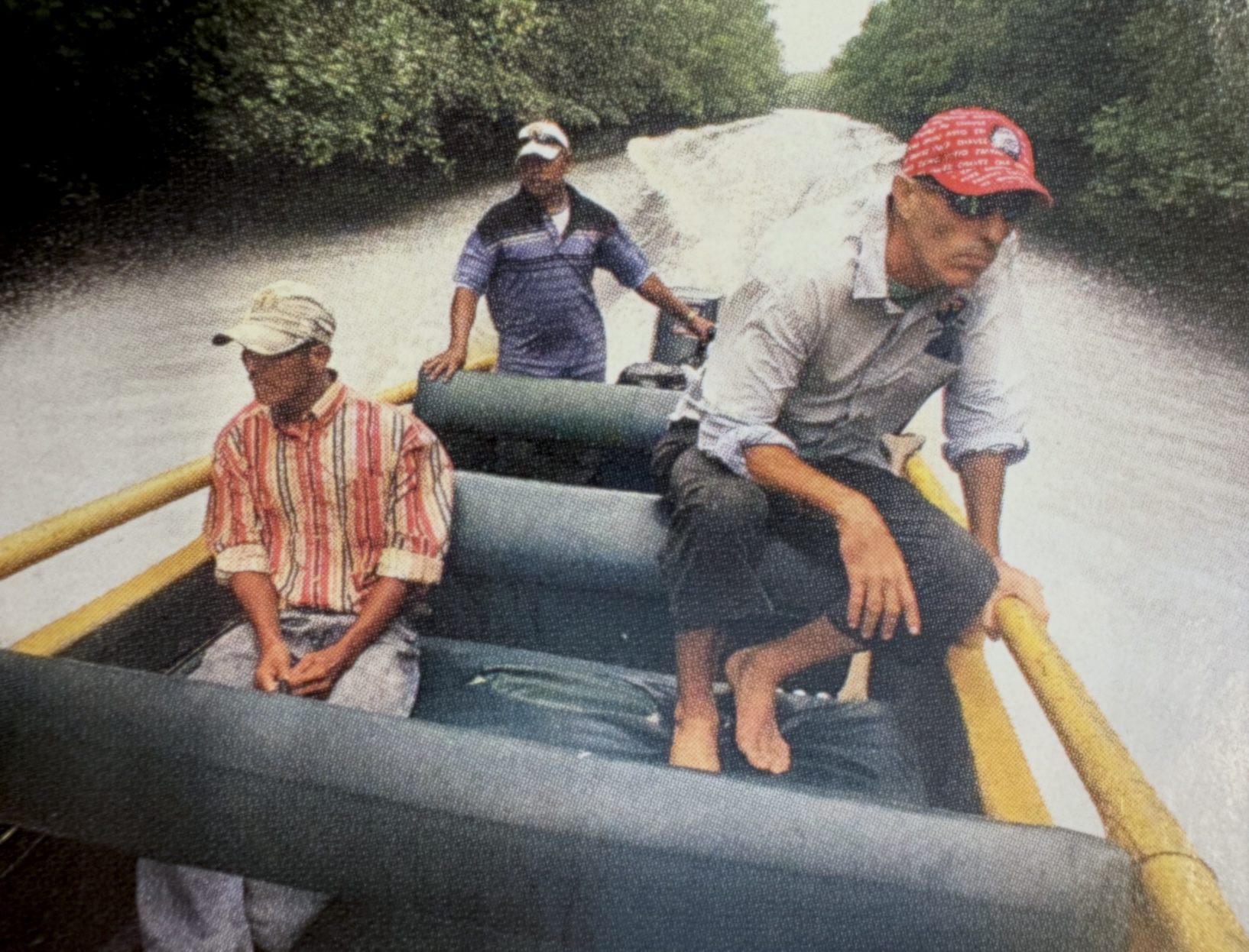
Venezuela, 2007
Words by Tom Bie Photos by Paul Kerrison
I saw the man with the machete first. He was leaning on the fat end of a downed mangrove that was blocking the way upstream. He stood on a branch chopping away, but his efforts had produced only a slight notch in the tree.
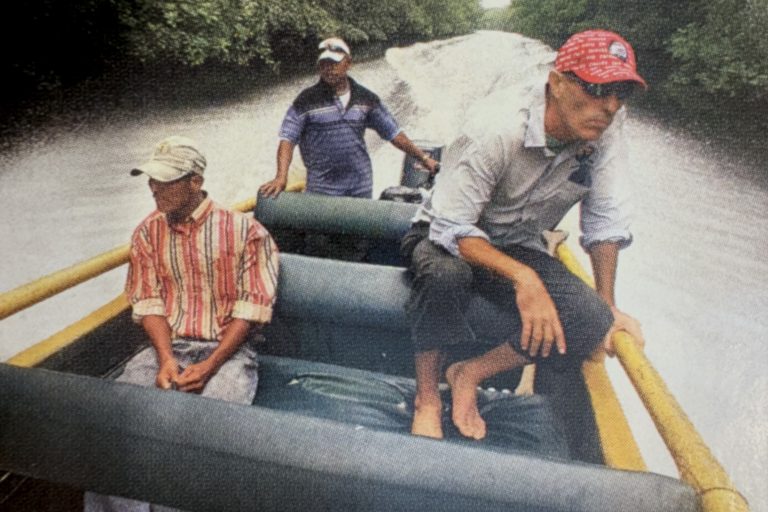
There were three others waiting in the boat, the youngest resting the butt of an automatic rifle on his knee. Their uniforms gave them away as members of Venezuelan president Hugo Chavez’s National Guard—as notorious as the waters they patrolled. The State Department estimates that 200 metric tons of cocaine makes its way through the country annually, much of it through this vast river system, which extends into Colombia.
As we motored closer our host Hani Tahboub shouted that he was reaching for his ax, thinking it would be a much-appreciated upgrade for the man on wood-chopping detail. As he lifted the tarp that covered our skiff, my eyes met those of the young soldier, who slid his hand from the butt of his weapon to the trigger.
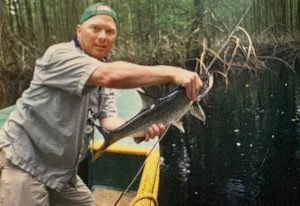
Fuzzy shot of Tom with a tarpon.
We had come to Venezuela’s Orinoco River delta in search of tarpon. Baby tarpon up to twenty pounds hide in the endless mazes of mangrove channels. Monster tarpon ten times that size roam out in the open ocean, where the Orinoco meets the Atlantic. But we were also here because of what is not here: roads, civilization, or a single other recreational angler. It was now clear that this solitude and remoteness also involved risk. If these men wanted us to disappear, they could make that happen quite easily.
As we stared at one another I recalled a story I’d heard about some fishermen from Trinidad, just seven miles off this coast, who were caught fishing in Venezuelan waters a few years back. This is viewed as a serious crime in this part of the world, and the Venezuelan National Guard—or pirates with stolen uniforms pretending to be them, followed the men back to Trinidad and shot at them as they climbed out of their boat onto shore.
At least, that is how the story is told in Trinidad, and I could think of nothing else as the four armed men appraised us coldly. I found myself wondering just how itchy a young Venezuelan’s trigger finger could be. But when Hani removed the ax from the boat and handed it to one of the soldiers, the tension evaporated. There was a burst of Spanish chatter, followed by gales of laughter that seemed to come at my expense. As we motored safely away, I asked Hani what he had said that made all of them point toward me and laugh. His answer: “I said, ‘He’s the American. Shoot him.’”
Like every other flyfishing tourist in Venezuela, I’d first headed to Los Roques, a collection of 100 or so islets sitting in the Caribbean eighty miles north of the Caracas airport. The Venezuelan government designated the 150-square-mile archipelago a national park in 1972, and it has been attracting anglers from around the globe ever since, in part because a bountiful sardine population helps fatten the bonefish there to leviathan proportions. The vast majority of flyfishing tourists spend five days on Los Roques and then fly out, having seen little of the mainland beyond the Caracas baggage claim.
I arrived on the islands in April with Australian photographer friend Paul Kerrison, who has spent the past six years splitting time between Venezuela and Mozambique, fishing, guiding sea-kayaking and hitting on unsuspecting European beauties. Just as I couldn’t fathom the idea of traveling to Venezuela and not fishing Los Roques, Paul couldn’t imagine going only to Los Roques. We managed to catch a few of the big bonefish the islands are famous for, despite fishing guideless, mostly so we could catch the cheap 11 a.m. shuttle to a nearby island with the European bathing contingent. It was a nice, relaxing few days, but each afternoon, over a local beer, Paul would mutter. “This isn’t the real Venezuela. We need to get down to the delta.”
The Orinoco River basin is the third largest in South America. Its delta covers 7,800 square miles and stretches from the tiny town of Pedernales in the north, down to the border of Guyana, and nearly 100 miles inland. When Christopher Columbus, on his third voyage, saw the massive amount of freshwater gushing out of the river’s mouth into the gulf of Paria, which separates Venezuela from Trinidad, he knew he’d finally found a continent, not just another island. Like an aquatic Club Med buffet, the Orinoco carries an incredible array of bait fish into the Caribbean. I’d heard rumors of monster tarpon prowling the area for years; while on a sea-kayaking trip to Trinidad I’d seen them rolling insolently on the surface.
So, after three days of dodging oiled-up, banana-hammocked Germans on our backcasts, we left Los Roques and took the short flight from Caracas to Barcelona (Venezuela, not Spain). We needed a good truck to reach the Orinoco, and Barcelona was where we were getting it, from the owner of an adventure travel company called Jakera, which Paul works for and which specializes in trips to the delta and other Venny adventures.
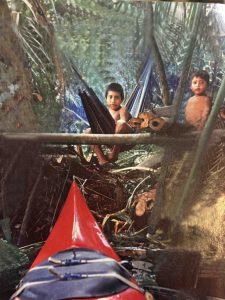
Young members of Venezuela’s Warao tribe, who have lived in the Orinoco Delta for at least 10,000 years.
Jakera, which means “beautiful” in the local Warao Indian language, is the brainchild of Chris Patterson, who first came to Venezuela from Scotland in 1996 at the age of 27 and didn’t leave for seven years. When he finally returned to Great Britain, it was on a 24-foot sailboat that he guided from Caracas to London with a high school friend, carrying 150 pounds of local herbal products and no navigational equipment. “We were lucky we found the right continent,” he says. A tall, good-looking, charismatic entrepreneur with curly sandy-blond hair, Patterson has an endless supply of colorful stories. He and Paul met four years ago when Patterson was serving as the “entertainment director” for a Russian billionaire with a bottomless bank account and an unquenchable thirst for all things South American. “He was organizing a party for his friends at this enormous castle in Ireland, where I happened to be at the time,” Paul says of his first meeting with Patterson. “He got in touch with me through a friend and asked me if I knew how to belay. I said I did but wanted to know who I’d be belaying. “Supermodels,” Chris said. “That’s how we met: belaying a couple of English supermodels off the side of a castle in Ireland.” The billionaire left a $40,000 waterski boat behind.
After dinner, the subject of ultra-populist president Hugo Chevez inevitably came up—this was not after he’d compared Bush to the devil on the floor of the U.N. “Look, I’m one of the people here with the most to lose because I’m a landowner, and Chavez could come and take everything I’ve got at any time,” Patterson said, rum and coke sloshing around in his glass. “So I see every reason to hate him. But then you see his people roll into these time towns, come up to a house and give three light bulbs to a family that didn’t have one. And that’s how he does it. That’s how he wins them over.”
Patterson had won us over by agreeing to lend us one of his Land Rovers for the fourteen-hour drive from Barcelona to the northern delta. The following afternoon Paul and I were motoring past grass huts along the Manamo River with visions of tarpon thrashing around in our heads. We cruised by countless small villages on stilts inhabited by the Warao, a tribe that has lived along the river for 20,000 years. As we passed through one village, a small boy ran down to the water, hopped in his little canoe, and did a Tony Hawk-like pirouette before turning and paddling away in one impressive, athletic motion.
“You’re only the second flyfishers to fish here,” says our guide Hani as we creep into a narrow but promising channel; despite the tea-colored water we can see at least a dozen or more baby tarpon swirling the surface. Alex was up first.
Alex Gonzalez is the owner of Pez Raton Lodge in Los Roques and the man largely responsible for pioneering and promoting the islands’ unique fishery. Gonzalez is the king of Venezuelan flyfishing, so naturally, when Hani wanted to assess the delta’s potential to attract foreign anglers, he invited Gonzales down for a test-drive. “We had tarpon fighting over the flies, because nobody fishes there,” Gonzalez recalls. “We probably caught close to a hundred.”
Hani’s brother Anthony had blundered into the area back in 1991, during a backpacking trip through South America. “I was surprised to learn that not a single camp or lodge existed here, in this magnificent part of the world,” he says. Anthony worked out a deal with the Warao to build a small eco-resort on their land; it has since grown from a couple of small huts to 17 cabins with toilets and showers, plus a main Lodge. He also built a school across the river for local children.
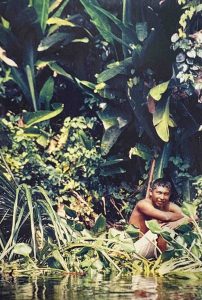
A Warao tribal member from one of the nearly 400 Warao villages scattered along the Orinoco Delta.
Hani’s idea to build a fishing lodge in the delta, an hour downstream by boat, seemed like a logical extension of the business, especially with Gonzalez’s strong recommendation. It also would help put some distance between the brothers, which was a good thing for all concerned. Hani opened his small Orinoco Atlantic Lodge in 2006, with the intention of catering to flyfishers. All he needed now were guests. Currently the lodge subsists mostly as an overnight stop for tourists looking for a change of scenery from the beaches of nearby Margarita Island or Trinidad and Tobago, or guests from Anthony’s lodge, who come for the epic sunsets and stay the night. We were the only anglers.
“The fish are there,” Gonzalez says, “but he doesn’t have anyone who knows anything about flyfishing. And most flyfishing clients who have the money to pay for these types of trips don’t know anything about flyfishing either. So, if neither the guide nor the client knows anything, that’s a tough combination.”
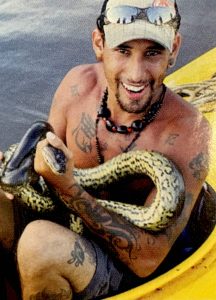
A local Warao guide holding a baby anaconda.
For skilled fly casters, though, the place offers plenty of fish, and Hani and his Warao guides know where to find them. This was obvious on our first foray into the mangroves, with the silver flash of Megalops atlanticus blasting after our flies on every other cast. Several times Paul and I were both fighting fish at once, hearing in stereo the trademark gill-rattle of jumping tarpon.
Of the big three saltwater flats fish— tarpon, bonefish, and permit—tarpon are by far the most visually thrilling. They’re the only ones that jump, and no game fish goes after a fly with quite as much gusto as a tarpon, inhaling it into that bear trap of a mouth. “Babies,” a term generally used to describe tarpon in the five to twenty-five-pound range, are even more exciting, since they jump more often. Baby tarpon have almost become an industry unto themselves in the northern Yucatan, as fat-walleted flyfishermen descend on formerly unknown destinations like Isla Holbox and Campeche.
Jungle fishing is a much trickier sport than wide-open Caribbean flats fishing. The narrow mangrove channels of the delta allow only enough room for short, precise casts into tiny pockets carved out of the dense jungle. It’s like fishing in a tunnel, but when we managed to land our poppers or streamers in the right spots, we waited only seconds before the surface exploded.
Occasionally a couple of Warao would motor by with a canoe full of fish, eyeing our gear and empty boat suspiciously: The Warao are relatives of the Yanomami, the famously reclusive Amazon people, and members of more remote sub-tribes might still go a lifetime without ever meeting anyone from outside. When you live in the middle of a five-million-acre soggy wilderness, you don’t see a lot of strangers.
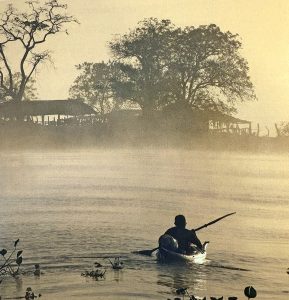
Morning paddle in a “bongo” canoe, some of which are built to hold up to five people.
Jakera and other adventure-travel companies have been making exploratory trips into the delta for years, walking for days in search of people who may be willing to have some visitors. But even asking for permission can be a dangerous proposition.
“There’s a reason these people have never been found,” Patterson had told us. “Make a wrong turn in there and you could end up with a dart in your neck and you’ll never wake up.” On our final trip from the lodge, we decided to make a day of it, motoring several miles deeper into the delta than we had been previously. The tarpon were everywhere, and they were hungry, so we fished until our forearms ached, then pulled up and pushed farther into the jungle.
The only downside to fishing an unexplored jungle river is that it’s almost impossible to turn around and head home. Even as evening falls and you begin to spy dark shapes pacing among the trees. “Just one more fish, Hani!” we begged, although we could barely even see our flies anymore. “Please? They’re right there!”
We knew we should probably listen to our host and not keep going deeper into one of the largest, wettest, and most maze-like wildernesses on earth, where our only hope of finding our way back to the lodge was the Warao guide poling stoically in the stern.
But, of course, we kept pushing, until our guide was forced to utter some of the few English words he knew: “You want to stay the night here?”
Not really. As we revved up the motor and headed back to camp, threading through a labyrinth of narrow passageways that all looked the same to me, we could feel the darkness pressing in behind us, reclaiming the jungle and blotting out any trace of our having been there.


Tom Bie is the founder, editor, and publisher of The Drake. He started the magazine in 1998 as an annual newsprint publication based in Jackson Hole, Wyoming. He then moved it to Steamboat, Colorado (1999), Boulder, Colorado (2001), and San Clemente, California (2004), as he took jobs as managing editor at Paddler, Senior Editor at Skiing, and Editor-in-Chief at Powder, respectively. Tom and The Drake are now both based in Denver, Colorado, where The Drake is finally all grows up(Swingers, 1996) to a quarterly magazine.