The look in my wife’s eyes suggested that what she was about to tell me would be a crushing blow. “I wasn’t able to get a ticket for you,” she said. “I’m so sorry.” The ticket in question was to Taylor Swift’s Eras Tour, which, in the world of our teen and pre-teen daughters, is serious currency. My wife had secured six such tickets to the sold-out concert at Raymond James Stadium in Tampa. All of which were allotted to my daughters, their friends, and their moms. I put my hands on my wife’s shoulders, looked her straight in the eyes and replied, “Don’t worry, honey. I’ll try to find something else to do.”
Despite the whole universe seeming to conspire against me, I made it to Russia for steelhead season this fall. Even better, I made it back home, although my mother and sister had their doubts. It wasn’t easy, to say the least. But I wanted to be there, and I felt it was important that I be there. Obviously, I do not in any way support the invasion of Ukraine. But I also don’t blame my friends in Russia for their government’s decisions.
The first email arrived on July 14. “Reaching out to pass along some fresh ‘industry happenings’ from the heart of Bolivia’s golden dorado region,” it began. “I figured the Drake might be interested in looking into it, as it seems on par with the prior articles investigating Deneki.”
Flyfishing for carp holds about as much appeal for me as getting a face tattoo. But what if my ancestors—or yours—were doing just that at the dawn of civilization? University of Connecticut anthropology professor Natalie Munro hypothesizes that this may indeed have been the case among the prehistoric people who regularly visited an ancient lake in what is today northern Israel.
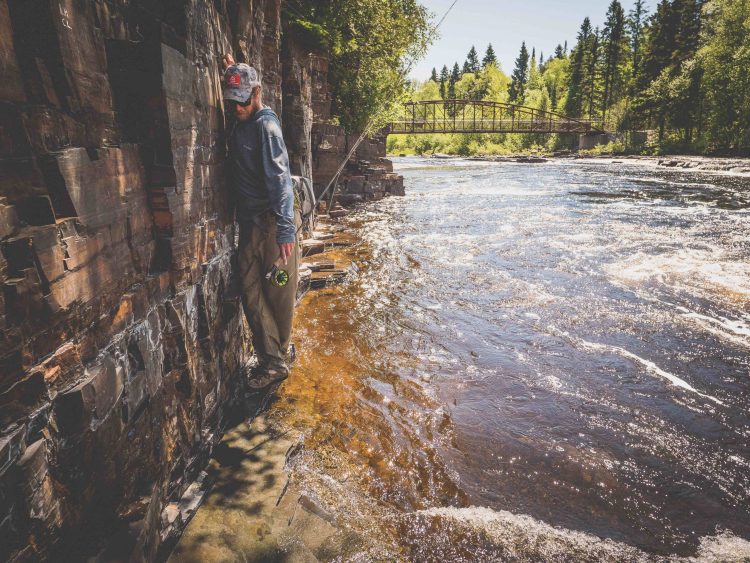
An always-appreciated view. Photo by Jeremie Hollman
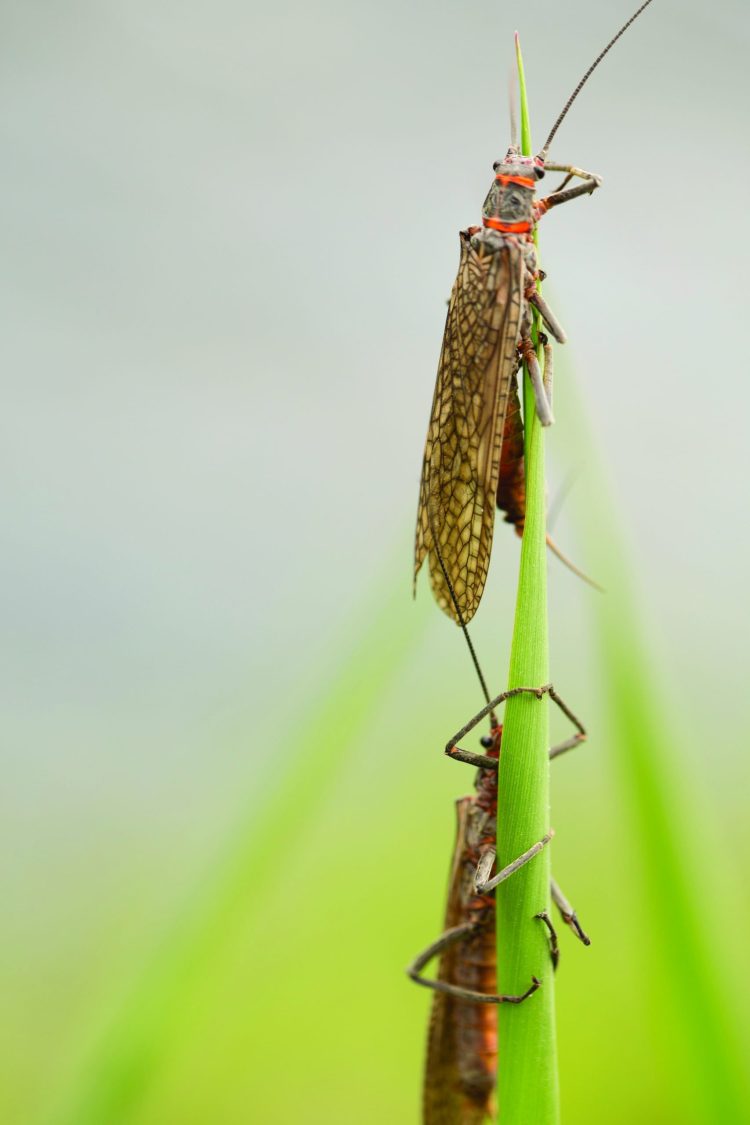
Living in Eastern Idaho allows me to fish some of the finest trout water in the country, from the South Fork of the Snake to the Madison in Montana. But lately, nostalgia has drawn me south, to northern Utah’s Logan and Blacksmith Fork rivers, both of which flow through the fifty-mile-long Cache Valley where I grew up. Each of these rivers had healthy salmonfly hatches when my grandpa was a kid, but now only the Blacksmith Fork does, and few people seem to know why.
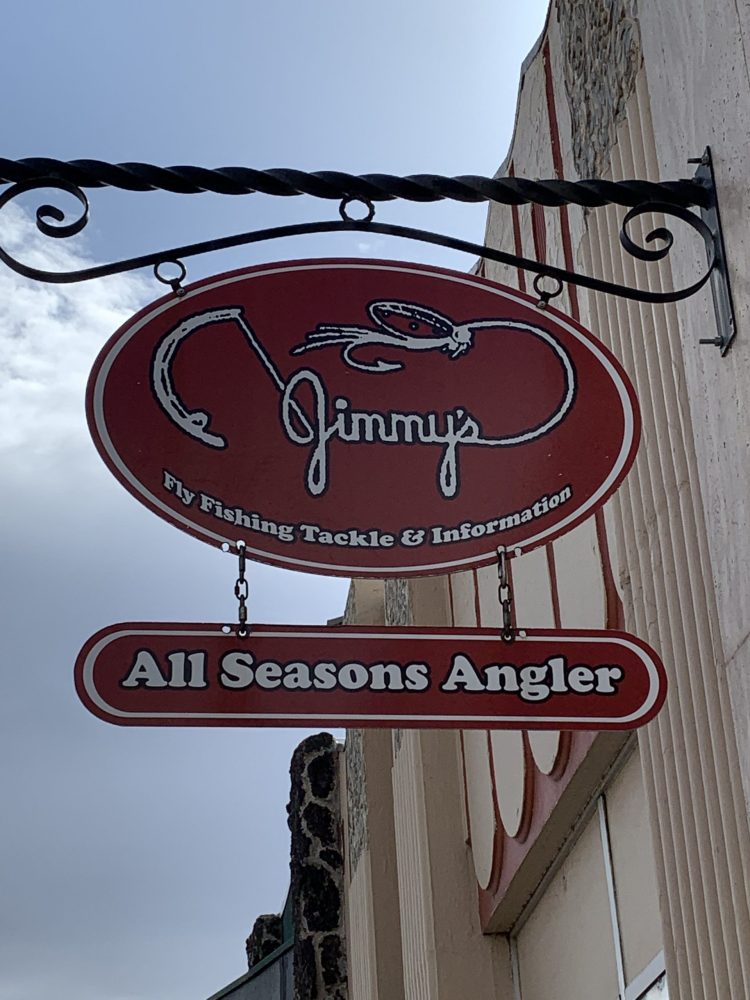
Jimmy's All Seasons Angler street sign. Photo by Beau Davis
Once known as little more than a railroad hub, prime agricultural center, and adjacent to the first economically viable nuclear reactor in the United States, the community of Idaho Falls has since become known as centrally located to some of the best trout fisheries in the country. These include the main Snake River, the Bear River, American Falls, the South Fork of the Snake, the Henry’s Fork, Yellowstone National Park, and more water in-between than you can literally and metaphorically shake a stick at. And, if you’re looking for one of the best all-purpose and all-species fly shops to service you in this flyfishing mecca, look no further than Jimmy’s All Seasons Angler in Idaho Falls.
Clouds and rain threatened as I stepped from the single-prop onto the tarmac at the Alaskan village of Galena, home to a few hundred residents along the north bank of the Yukon River, 270 air miles west of my home in Fairbanks.
I knew Patrick had a wedding the night before, but I didn’t know he’d be coming straight from it. His wine-stained dress-shirt hung untucked over his pants. He had no bag; he walked up my driveway from our mom’s car just after 5 a.m. with a five weight in one hand, a pair of cowboy boots in the other, and a hip pack and a pair of jeans slung like saddlebags over each shoulder.
The words felt strange as I texted a quick report to my friend Dave. But it was true; I’d spent the better part of the afternoon Euro-nymphing, and the fishing was indeed ridiculous. Within the first hour, I had already hooked more than a dozen; by hour two, I lost count. Wild browns—nice fish up to 18 inches—with the occasional thick, foot-long brookie mixed in. In the evening I switched to twitching attractors in some fast runs and landed another ten or so until I finally quit at dark.
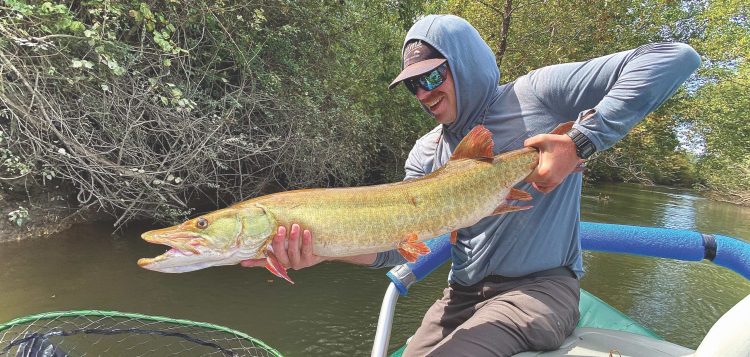
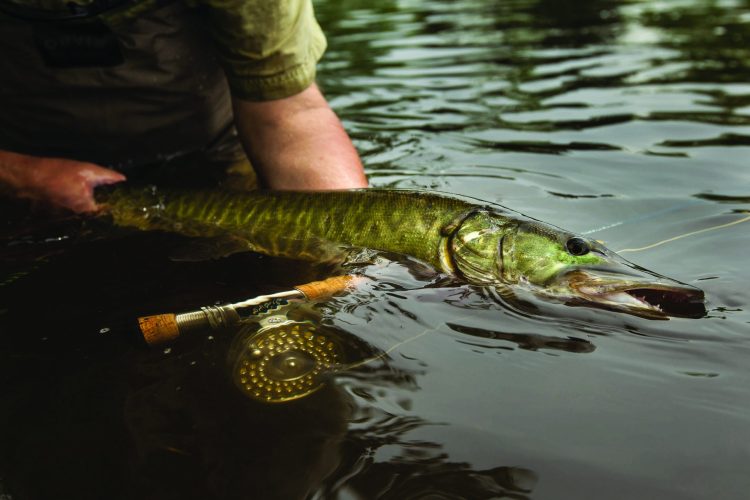
The author holds his hard-earned musky. “Great works are performed not by strength, but by perseverance.” –Samuel Johnson.
Photo by Brett Meany
Hours into the float already, we’d chucked green and yellow, chartreuse and pink, and black and purple—some with big reflective eyes and others with barred feathers that enticingly slip and slide behind the body of the fly. Nothing was working. Brett, my musky copilot, and I weren’t moving fish like I thought we would, considering the cold mornings that fall had been delivering.
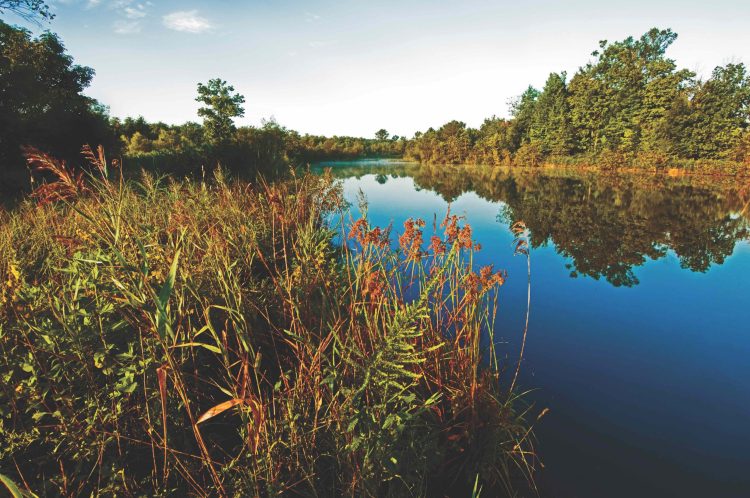
Late summer over the Patoka River near the Patoka River National Wildlife Refuge (NWR), Indiana, USA. Photo by Brent Waltermire
In the fall of 1993, then-President Bill Clinton signed Executive Order 12866, requiring all Federal regulatory agencies to publish a list of anticipated rulemaking actions for the upcoming twelve-month period. The U.S. Fish & Wildlife Service (USFWS) is such an agency, and its rulemaking process requires four steps: Publishing a proposed rule in the Federal Register; Inviting public comment; Considering the public comments received, and Publishing a final rule in the Federal Register.
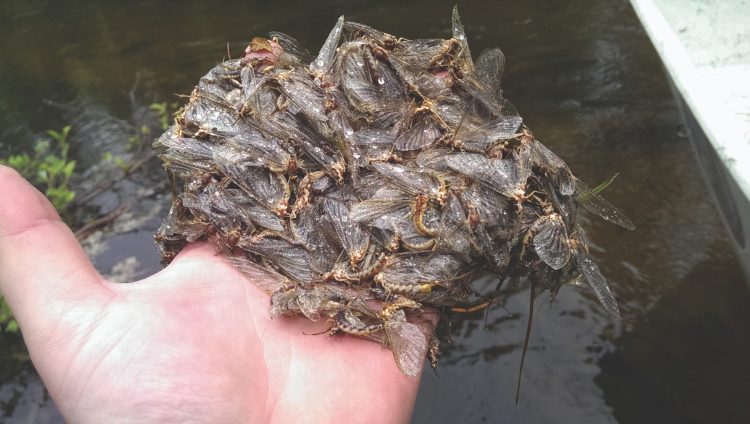
If Hexagenia limbata isn’t the GOAT of all bugs, it’s at least squarely in the conversation, beginning with its sheer size and density. “Nothing in flyfishing even comes close to the spinner fall,” says the legendary Kelly Galloup in Chris Santella’s book, The Hatch is On! “I don’t care how big a salmonfly or Mother’s Day caddis or Hendrickson hatch you’ve seen, it doesn’t compare in pure biomass.”
A few months ago a family friend gave me a taxidermied brown trout that had been mounted in the 80s. When I went to the friend’s house to get the story behind the fish I somehow left with the rod and reel that had caught it, plus a whole lot more. This episode is the story of that fish, the rod, and the anglers that came before us.
I was caught between two worlds: human and piscine. I had been welcomed into the school. I moved with them, as they moved. I observed their feeding habits, their societal structures. I was like a salt-crusted, Ichthyological Jane Goodall, except that my silverbacks weren’t gorillas. They were bonefish. Scores of them. Possibly hundreds. All around me, glimmering tails flapped like the banners of their clan—a clan of which I was now an adopted son.
I wish I knew more about bourbon. All I really know is that I like the taste, and that there are some I enjoy more than others. This may be the result of growing up in Kentucky, where my friends and I were introduced to good bourbon at an early age. Had I grown up in Poland or Scotland or the Caribbean, perhaps I’d prefer vodka or Scotch or rum. But bourbon is my thing. The details don’t interest me, however. Percentages of various mashes, types of wood in the barrels, the aging process? I just don’t get it. From people with more discerning palettes, I’ll hear things like “vanilla overtones” or “notes of cherry and chocolate.” Here is part of an actual description I found on a website for one of my favorite Kentucky bourbons:
“The topic of stream access illustrates one of the most perplexing types of legal conflicts that can arise… Indeed, it is difficult to find a legal issue that is more tangled and uncertain.” —A Wildlife Primer (2009), by Eric Freyfogle and Dale Goble
Colorado’s river laws might be in trouble. Roger Hill, the octogenarian trying to fulfill his dream of legally wade-fishing the Arkansas River, was at the Colorado Court of Appeals on January 27 and got good news about his case—Hill v Warsewa.
There was no doubt it was a steelhead. Until it wasn’t. The grab had been so jolting, the head shakes so violent, that no consideration was given to the fish being anything but a steelhead. Yet there at my feet, in six inches of water, lay a brown smallmouth of grotesque proportions. Pulsing and flexing, flaunting its outsized strength.
Now I understand how Mugato in Zoolander felt. Everyone at the fly shop is picking out different hackle, feathers, and fur, and here I am at the fly counter grabbing fistfuls of pre-tied adams and caddis, feeling left out for not tying my own.
In the middle of the journey of our life I found myself within a dark woods where the straight way was lost. —Dante Alighieri, The Inferno
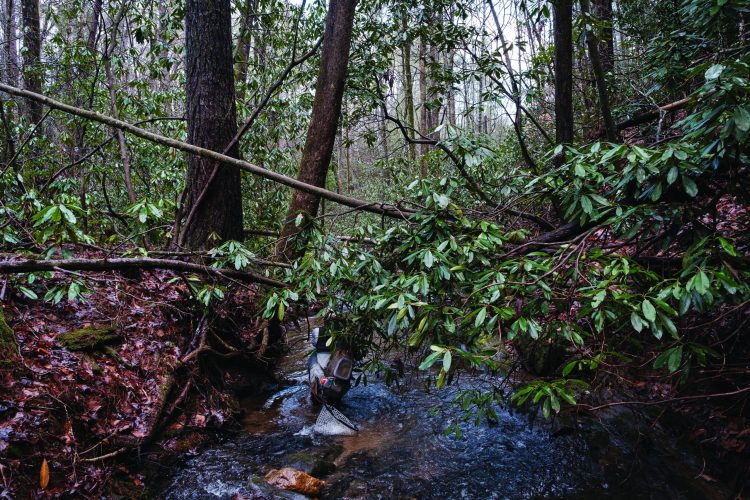
In Appalachia, there’s no straight way to travel. Laurel hell grows thick, and the only way to navigate it is to put your feet in a streambed and follow every meander and oxbow of the creek.
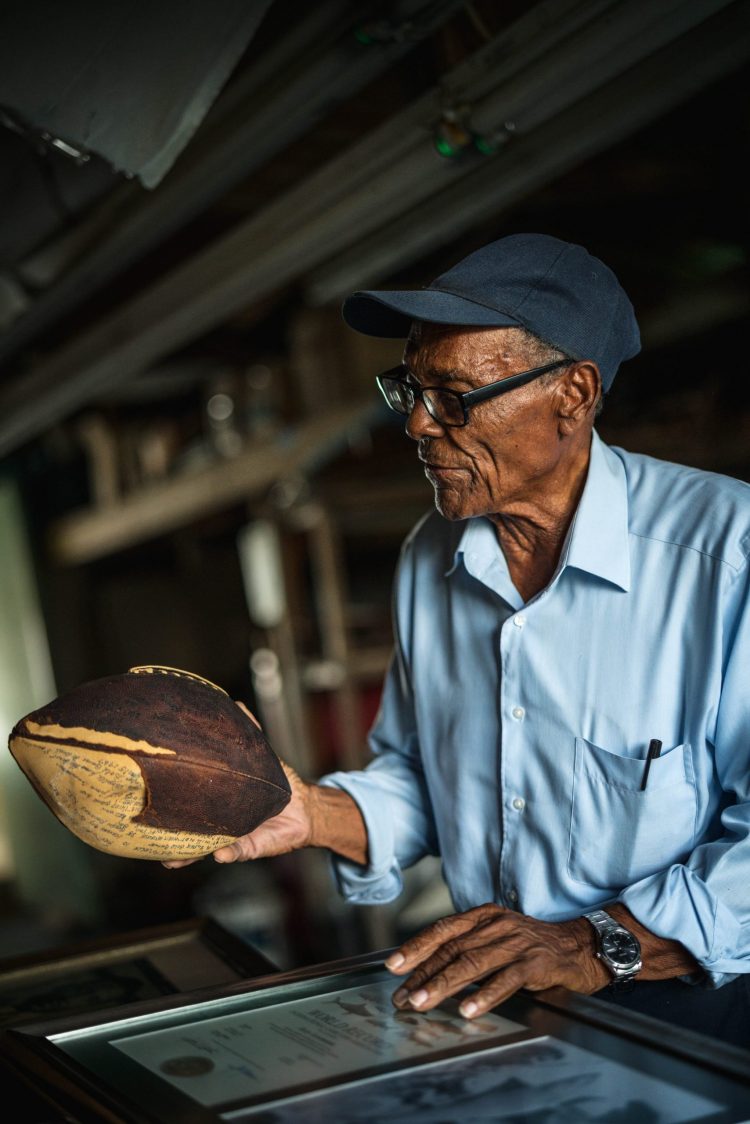
Bimini guide Ansil Saunders appreciating the Super Bowl I game ball
Mighty Waters, a wonderful movie released last year by Austin-based filmmaker Shannon Vandivier, tells the story of beloved Bimini-based guide and boat-builder Ansil Saunders, in particular how Saunders had taken Dr. Martin Luther King Jr. out for a peaceful day on Bahamian waters just four days before King was assassinated in Memphis on April 4, 1968. The fascinating story was part of the 2021 Fly Fishing Film Tour and was broadly shared with the public in early February by two of its sponsors, Simms and Costa.
The setting is the dining room of a fishing lodge in remote northern B.C. It’s early morning on a gray, drizzly day during a very slow week. Levine, one of the anglers, is talking to the head guide before the rest of the camp has come in for breakfast.
I find it best to begin all writing about flyfishing by first writing about hunting. Or, alternatively, the Asian culinary arts. I’ll start this one by talking about Boomer.
Sitting on my fly-tying desk, on a shelf above the straggle chenille and holographic tinsel, is an 80-year-old Richard Wheatley fly tin. The edges of its aluminum lid, with that distinctive satin finish, are rubbed bright from the friction of bouncing about in a fly-vest pocket. It bears the inscription:
There are two primary fishing cultures in Alabama: 1) The esoteric and exceedingly idealistic group of anglers that enjoy flyfishing and eating greasy Jack’s biscuits before a fishing trip. 2) Ricky-Bobby types who fish with junk baits. Needless to say, tournament pros burning up the interstates and roaring across impoundments with their 250-horse motors vastly outnumber those with “tippet” on their shopping list.
EmergenceSometimes, the fishing comes second By Britton White Emergence It was late morning on a sunny, calm, late-summer day. I’d been wade-fishing for a couple of hours along the Colorado River, a few miles downstream from my home in Carbondale. The only visible insects were a few tiny mayflies and midges hovering about twenty feet…
Memorial Weekend is typically a time to avoid fishing. But Clyde opens doors. And gates, with bass ponds behind them. I’m not a private-water-with-pellet-fed-trout guy, but access to an un-public largemouth lake in Tennessee? That’s another matter.
My older brother Charlie—the red-haired menace of my youth, and the protagonist of so many fishing adventures—came to visit me in Canada. It was mid-August when I picked him up from the airport. He was hungover and indignant, as one of his rods had been lost in transit. We headed straight for a well-regarded trout stream in southern Ontario where there were rumors of giant browns, stopping eight hours later at the local fly shop to book a half-day trip with some dude named Larry.