

Dworshak Dreams
By Michael Wright
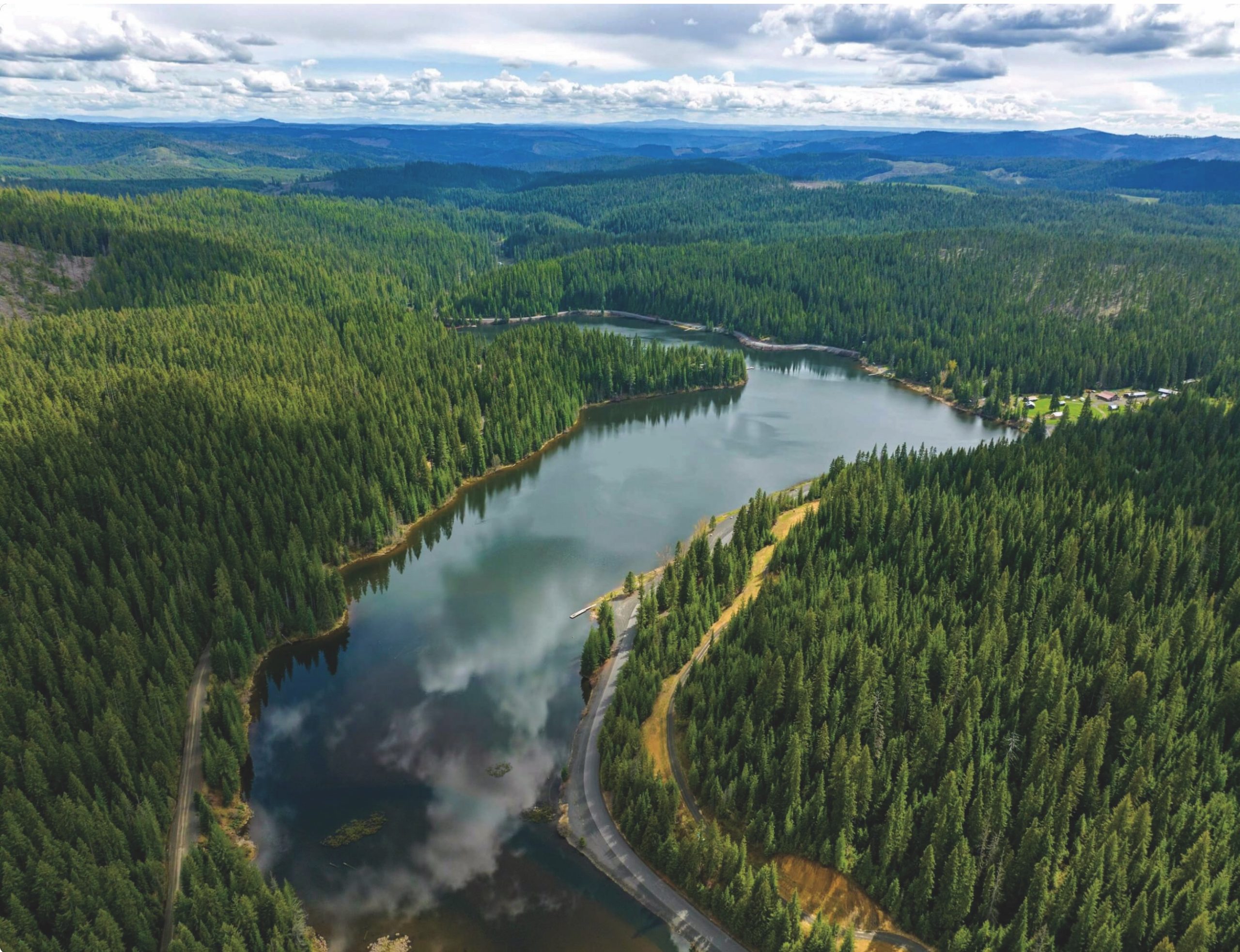
A float tube is the wrong vessel for Dworshak Reservoir. The lake is more than fifty miles long, nearly twenty thousand acres, in some of the wildest country in Idaho. A friend who hunts elk in the surrounding forest, usually from a boat-in only campsite, refers to the lake as “Big D.”
I knew all of this before I showed up there in early May to search for smallmouth. Yet there I was, shouldering a float tube to a beach a few hundred yards from the launch, trying to avoid hearing the jet-boat crowd laughing when I strapped fins on.
There was a cove south of the ramp that had a rock wall on the far side, a little more than a quarter-mile from where I put in. A few gear anglers were already fishing it, but kicking over there took long enough for them to get bored and leave.
It was also long enough to make me dread the return trip. Then the first bass ate a deerhair popper and I forgot all about it. For the next hour, I plop-pause-stripped my way down the rock wall. A bass came out of every likely spot—wood piles, boulders, small weed-patches. The best one chased the fly for a few strips before inhaling it and then diving deep, swimming beneath my feet. It was around a foot long and maybe weighed a little more than a pound. Not bad, but nowhere near the size of the trophies that can come out of this lake.
Dworshak is responsible for all of Idaho’s biggest smallmouth. The lake outside of Orofino has produced each of the state’s certified weight records since 1982. The catch-and-release record, which is measured using length, is a 23.75-inch beast caught in mid-December 2022. That fish happened to be the same length as the certified weight-record bass—a 9.72-pounder caught in 2006. Dworshak most likely holds a few ten-pound smallmouth, and possibly one topping the world record of eleven pounds, fifteen ounces.
These bass are one side of a bittersweet tradeoff. The reservoir exists because of Dworshak Dam, the third-tallest dam in the country. Completed in 1973, the 717-foot behemoth impounded the North Fork of the Clearwater River, remaking the landscape and consuming thousands of acres of forest. It also blocked salmon and steelhead from accessing the North Fork drainage and its miles of spectacular habitat, effectively killing off one of the largest strains of steelhead on earth.
There are still anglers around who remember life before the dam, when the only ten-pounders they dreamt about were salmon and steelhead. Many more have heard the stories.
“I’ve got pictures of my granddad with salmon and steelhead across the whole tailgate,” said Drew Evans, flyshop manager at House of Fly in Lewiston. “Those days are long gone.”
At the time it was built, proponents argued that damming the North Fork was crucial for taming the mighty Columbia River watershed, which flooded badly in 1948 and washed away the town of Vanport, Oregon. Dam proponents identified a spot on the lower end of the North Fork drainage that would work, just upstream of the town of Ahsahka. Some people raised concerns that the dam would end a great fishery and bury thousands of acres of wildlife habitat, but there was no turning the tide. Congress approved the dam’s construction with the Flood Control Act of 1962, and construction crews got to work.
It’s hard to miss the dam when driving between Lewiston and Orofino on Highway 12. A steelhead hatchery sits on the banks of the Clearwater, and Dworshak rises behind it, a big chunk of concrete plugging a hole in the forest. It’s a foreboding sight, especially when you let yourself imagine what used to be.
Fifty-two years after its completion, however, some people seem to be nearly at peace with the tradeoff. Dam-breach advocates don’t talk much about Dworshak, partially because removing the lower four Snake River dams is a big priority. It’s also hard to imagine the work it would take to dismantle and haul away all that concrete. And where the water would go.
Dworshak has given people things to like. Even steelheaders acknowledge that the dam is a consistent source of cold water for the main Clearwater, keeping it cool for summer steelhead. The reservoir itself is remote and gorgeous, offering boat-in only access to a lot of wild country. Then there’s the smallmouth.
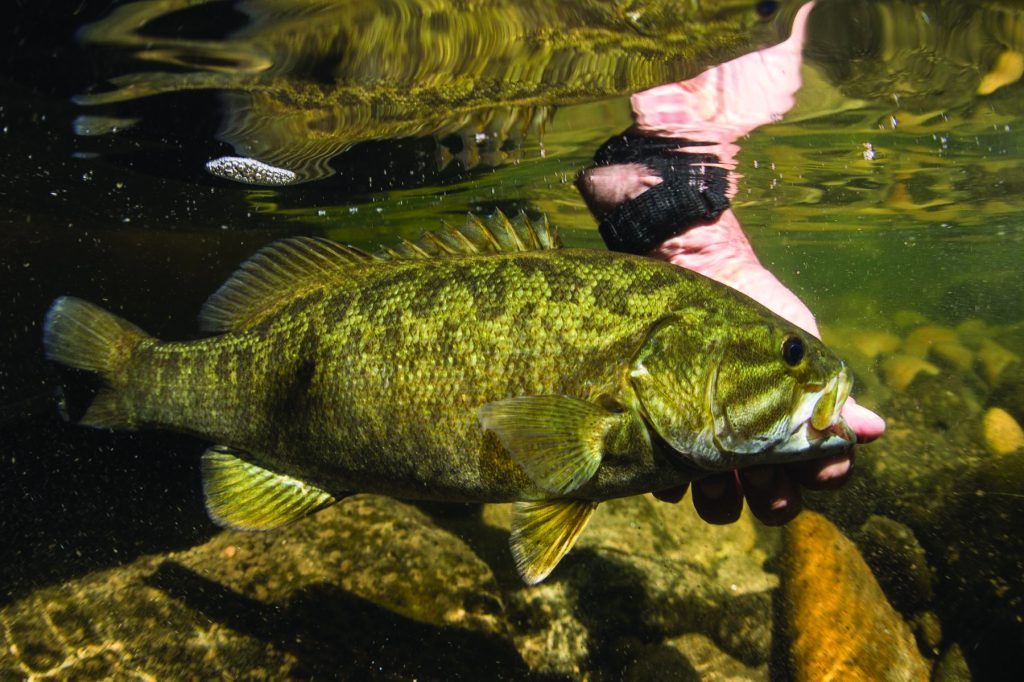
A well-fed Dworshak Reservoir smallmouth. PC: Flying B Ranch
Stocked not long after the dam was built, smallies grow so well in the lake because of its kokanee salmon, a landlocked strain of sockeye that makes fantastic bass food. Biologists have found that the kokanee population determines how fast bass grow, as well as how many true trophies exist at any given time.
Tyler Zumwalt, a biologist with the Idaho Department of Fish and Game (IDFW), told me that kokanee are “density-dependent,” meaning populations tend to go through boom and bust cycles. High numbers one year means there’s not enough food to go around the next year, leading to a population crash.
Bass growth-rates mirror those cycles. When there are a lot of small kokanee, bass grow quickly. When kokanee numbers are down, bass growth slows. IDFW estimated there were less than five million kokanee in Dworshak in 2024, down significantly from 2021, when their estimate was north of nine million.
This translates to IDFW officials expecting fewer trophy bass in 2025 than in years past. “You can catch smaller fish all day,” Zumwalt said. “But there’s certainly big fish out there as well.”
IDFW doesn’t have a population estimate for the smallmouth because they’re hard to sample, but Zumwalt said they’re found throughout the lake. A few years back, bass that were weighed at a tournament near the dam, and then released, were later found at the far north end of the lake, nearly fifty miles away.
In spring, smallmouth move to shallower water to spawn, but it’s still not easy to find the true trophies. Evans, the flyshop manager, said gear anglers chasing records are generally using livescopes and fish finders, and that they’re finding them most consistently at depths of sixty or seventy feet.
Evans’ parents have had a cabin near the reservoir for most of his life, so he’s spent a lot of time there. He is one of a small number who consistently flyfish the reservoir. He loves poppers in the summer, but mostly focuses on matching the kokanee hatch with Game Changers and other big baitfish patterns. His best bass on a fly topped five pounds. “There are unicorns out there that want to play,” says Evans. “And you might find one.”
Evans also recognizes the history buried underwater—old houses and logging camps along a once-great steelhead river.
While he admits that it would be nice to pile up salmon and steelhead like his granddad did, Evans knows there’s no turning back the clock, and that there’s plenty to like about having a world-class bass lake so close to home. “I love warmwater fishing,” he said. “I kind of dig having a fishery like that here.”


Michael Wright
Michael Wright is the outdoors editor at the Spokesman-Review newspaper in Spokane, Washington. And yes, he really does like Spokane.