
Hungry Trout Fly Shop
By Peter Vandergrift
Photos courtesy of Hungry Trout & Bobby Eckert
Evan Bottcher grew up in the Hungry Trout Fly Shop located in the heart of the Adirondacks. The shop is deep in upstate New York about 90 minutes south of Montreal, Canada. “I would get off the school bus at my dad’s fly shop and hang out until my mom got home,” Evan says. “In those days, it felt like it was full of old timers. It was all anglers older than 50.” Evan, who took over the shop from his father in 2011, explains that in the last decade the younger guides and patrons have given the shop a new, cooler spirit. “The industry has evolved. It is more affordable for people to get into the sport now with less expensive packages, new techniques, and new flies,” explains Evan. “But there is so much knowledge from the old timers that will be lost if it isn’t written down.”
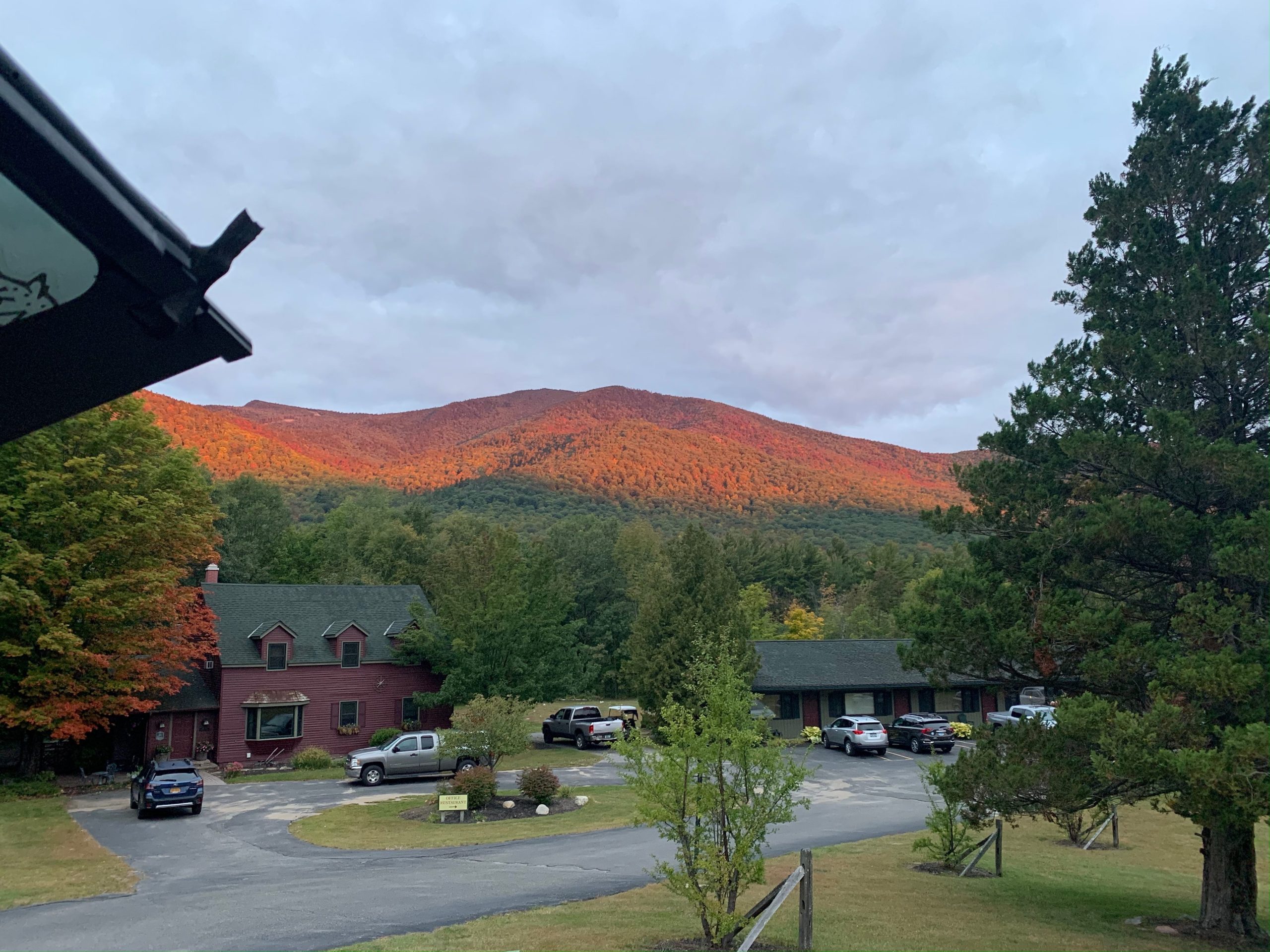
The shop is located in one of the epicenters for fly-fishing tradition in America. It is on the banks of the Ausable River, hallowed ground in its day. The popular West Branch of the Ausable spills from Mount Marcy, the tallest peak in New York, and drops more than 3,000 feet in just under 36 miles before meeting the main branch, giving the river a rowdy pitch.
One piece of old-timer intel that has served Evan and his staff of crack guides well, is the understanding of how a rainstorm in the mountains will affect the downstream flows. “We have learned that there is about a 12-hour delay from when we see a surge of water at the shop from rain to when we can go upstream and get behind the surge and the river will fish,” he says. “I learned that hanging around the shop from the older guides.”
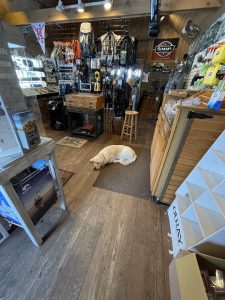
Caldwell warms the Hungry Trout Fly Shop floor
But with numerous other streams, lakes, and ponds in the area, their savvy guides, like the legendary Rachel Finn, always have a few tricks to find good water.
“It takes a lot of leg work to find the hidden gems.Thirty three years of pounding the ground, time and again. We make a lot of lemonade here,” says Rachel. “It is a fragile area and with climate change we have to be adaptable. I have also tried to add warm water fish to my game, but at heart I am just a trout bum.”
Rachael, a Patagonia and Scott ambassador, is still searching out new water, which is thankfully in abundance. At 6.1 million acres, Adirondack State Park is larger than Yellowstone, Everglades, Glacier and Grand Canyon National Parks combined.
The fishery houses large browns and rainbows but is also a stronghold for native brook trout. You can throw big attractor flies like the traditional Ausable Wulff, as well as the Ausable Haystack, Ausable Bomber…both creations of Francis Betters, a local legend and an underappreciated fly and rod innovator according to Rachel.
But flies have come a long way, and the shop offers old and new patterns, tons of gear and apparel and rental equipment for those looking to wet a line. Being adjacent to the Hungry Trout Resort and restaurant ensures a good stream of fly-curious customers wander over.
The area has a long history of tourism with rail lines being cut in the late 1800’s to bring the likes of the Rockefellers, Guggenheims, and Vanderbilts north to relax in their “Great Camps” which survive to this day. These social elites spawned an onslaught of tourism in what came to be a proving ground for some of the first American guides. They fished out of distinctive Adirondack skiffs known for their stability. Although the use of these boats has faded and been replaced by small rafts, you just might catch the sight of one slinking across a pond early in the morning
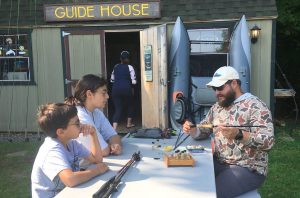
A Hungry Trout guide explains the butt section of a fly rod to a pair of youths
The landscape of the area was immortalized by Winslow Homer, the preeminent 19th century American painter, who made frequent trips to camp, fish, and paint. Homer was mostly self-taught and painted scenes of both the elite on vacation and the serious woodsman in his element. The Hungry Trout still plays host to both types of tourists, and everything in between. Fishing peaks in May and June and then again in September and October.
Staff have created programs to engage newcomers, families, and, especially, young anglers. Programs include 2-hour Family Learn to Fly Fish, Brook Trout Adventures, and their free Emerging Anglers Youth Initiative. The Youth Initiative is run by volunteers who teach local school children from 5th to 12th grades about the river, fly fishing techniques, ecology, and conservation. Guiding grouse hunting and ice fishing help fill in the fall and winter months.
“Some folks come just to put on the costume and have the experience,” says Evan. “The 2-hour family courses are very popular. Some folks can’t commit for more than a couple of hours. We just had a kid that we taught to fish when he was 10 graduate from college and he and his family have been coming every year.”
You can visit Hungry Trout Fly Shop in Wilmington, New York or at hungrytroutflyshop.com
Confessions of a Flyfishing Concubine
Flyfishing is a sexy sport. This I know because I’m in awe of good fishermen, which has left me attracted to grubby guys I normally wouldn’t have noticed except maybe to offer them change. I’m not too experienced a flyfisher and I’m a terrible flirt, yet when it comes to mixing the two together I…
Northwest Flyfishing Outfitters
When John and Shirley Hagan first opened Portland’s Northwest Flyfishing in May of 1993, Czechoslovakia was dissolving, Rodney King was testifying, and the Second Coming of the Spey rod was still a decade away. But 17 years later, the Hagens still offer the quality products and service that East Side Portlanders have come to expect.
T. Hargrove Fly Fishing, Inc.
In a town crazy for baseball, there are at least a few people in St. Louis, Missouri, that regard the Cardinals as mere amusement—something to occupy their time while driving to some of the most underrated flyfishing streams in the Lower 48. Many of those drives start at T. Hargrove Fly Fishing, tucked off Interstate…
The Otter’s Den
About a month ago we received a letter signed by a dude named Matt. He claimed he’d stumbled upon a flyshop so amazing, so gritty, so real, in a state so blessed—or cursed, choose your poison—with outfitters, that we must share it with you. Sensing the big scoop, we dug deeper. Matt told…
Oak Orchard Fly Shop
There are two types of fly shops out there, destination and local. Oak Orchard Fly Shop defiantly falls into the latter category. Of course this was not always the case.

Northwoods Angler
WHITEFISH, MT—Scott Fenwick says Northwoods Angler “isn’t your regular fly shop.” It only takes a few seconds inside to understand what he’s talking about. There are rare books, collectible paintings, antique signs and surfboards scattered among the requisite flies, rods and other fishing gear. In one room, underneath a television displaying a flyfishing adventure documentary,…

Peter Vandergrift has spent his life working in the fly fishing industry. His first two decades were wasted as a guide and outfitter in Montana, Alaska and Wyoming. He was then lured away by the industry working for Simms, Costa Sunglasses and a smattering of other brands. He spent time as a newspaper journalist and his articles can be found in a smattering of fly mags and western rags. He lives in Missoula, MT with his wife, two river-rat daughters, and a buxom Lab, Suzie.