

Untanglers Anonymous
BY BRIAN DELOACH
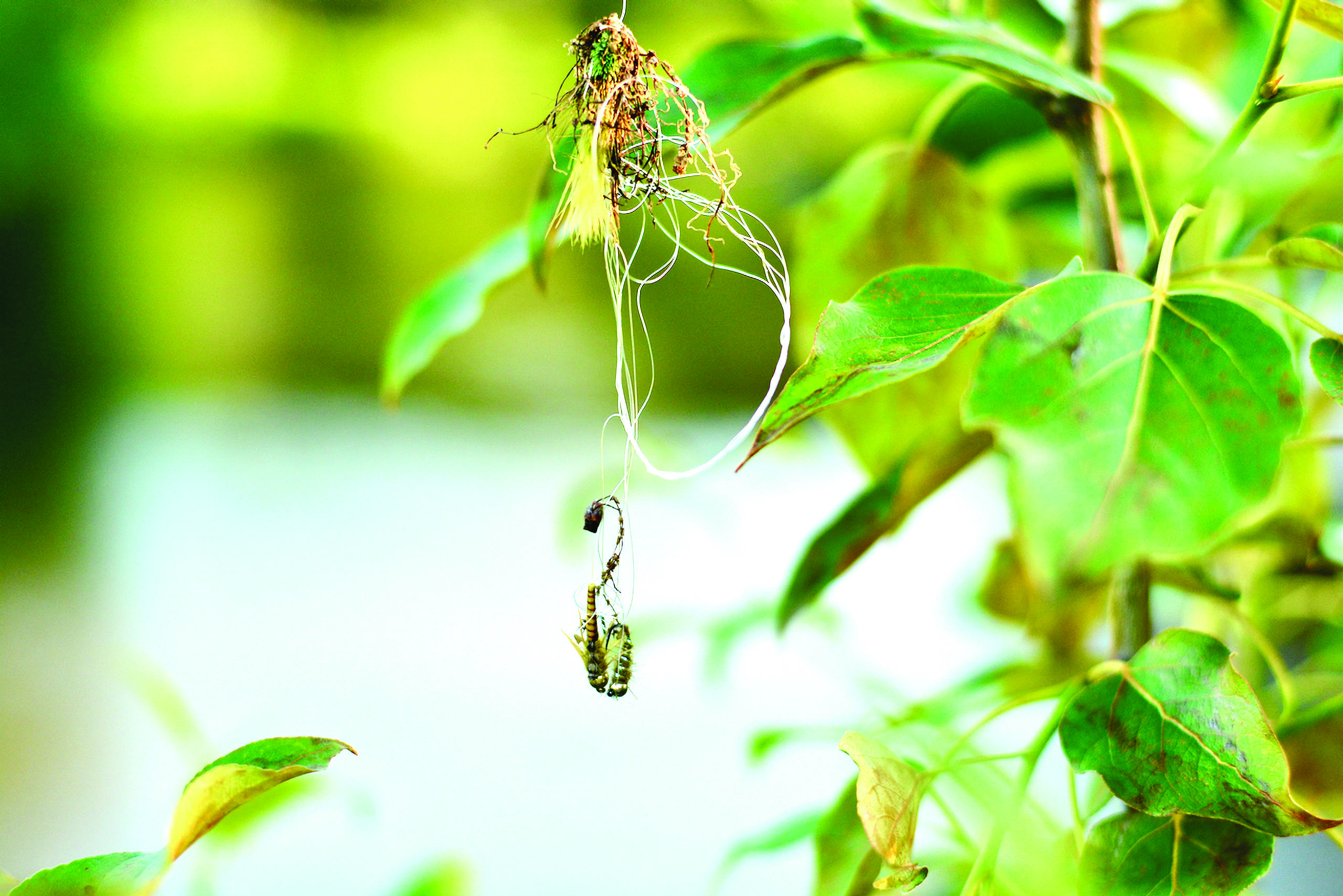
ONE THING BEGINNING fly anglers should be taught is the importance of knowing when to quit. In certain sports, sheer will and dogged determination are critical to success, but this can backfire in the case of tangled leaders. Every seasoned guide has witnessed this: The caster has missed a hookset or thrown a tailing loop into themselves or committed some other cardinal sin resulting in an infamous bird nest. Their rod is draped with a wet girdle bug, some split shot, a size-18 pheasant tail, and a strike indicator, all webbed together with dripping coils of crisscrossed fluorocarbon. Without fail, the new angler will ignore the line nippers hanging from his neck and instead set about trying to untangle the jumbled snarl while avoiding having to snip or re-tie any part of the system.
After ten minutes of futile effort while floating by four prime log jams and countless fishy seams, the swearing from the bow can be heard echoing downstream as our tragic hero unsuccessfully weaves his rigging into increasingly complex webs. The flies, with their tungsten heads, bolo and tether around the rod’s spine, and at this point, from the guide seat, we cautiously offer to “take a look” at our poor client’s mess.
A snappy “No, I’m almost there” assures us that the sunk cost fallacy is alive and well on the water in 2024—he’s got too much time, energy, and effort invested in sorting out the tragic snarl. To quit now would surely be a sign of weakness to a universe that is actively trying to break us daily. Furthermore, it would be un-American to give up on untangling the knot. Meanwhile, the fish beneath us swim happily unharried because, for the past twenty minutes or so, our sharp hooks have been safely wrapped around a $900 fly rod. After the fourth or fifth “I’ve almost got it!” I find a slow spot to anchor and start rummaging in the cooler for something to take the pain away.
The knotted-up client is committed to undoing his knot as almost a penance for his mistake. And he’s not open to being talked out of it. He “ain’t no quitter,” as he mumbled back at me, annoyed that I would dare offer to fix it for him. He’s a man, dammit, who finishes what he starts.
What is needed to offset this time-wasting situation is a shift in framework. We should be introducing new anglers to the inevitability of unwanted knots and tangles not as a negative but as an opportunity to practice their terminal knots and rigging abilities in real-time. Instead of getting bogged down in the spider’s web, the new angler should be rejoicing at the chance to snip apart the whole morass and practice their leader and tippet knots—thus improving the speed, quality, and general dexterity of their knot-tying game.
Now, when either a student or my own clumsiness causes a tangle, I ignore that temptation to navigate the bird’s nest, as well as the nagging Catholic guilt that says I must have penance for my mistake. Instead, I quit hard and quit quickly, snipping off the whole mess in order to practice those knots.
Every mistake is an opportunity in disguise, and it is no different in this situation. After three or four minutes my flies are back in the stream, in play, while the poor fool, who hasn’t yet seen the hidden opportunity in his tangle, still holds his mess of flies precariously looped around his rod, whispering to himself all the while, “I ain’t no quitter.”

Brian DeLoach

Forty years of casting (miscasting!) flies has taught me the qualitative difference between a hopeless mess and just a few short moments of de-tangling. Therein lies the judgment, to be or not to be. Whether to suffer the slings and hooks of outrageous fortune, or to nip it off in the bud. Time on the water. Time on the water.
Because I I buy only knotless leaders, i have never experienced any tangles personally… but when a client is careless enough to tangle their line I boost their spirits by pointing out how difficult it would be to duplicate the objet d’art they have just created. They should take the time spent untangling their articulated streamer trailing three weighted midge nymphs as a growth opportunity. It’s an opportunity to discover the mysteries and magic of topology.
Sadly, in today’s world too many anglers lack patience, and ask for a different guide for the next day.
100% high quality guide right here. Anglers should take the time to learn to fix your mistakes, not constantly cutting and re rigging, leaving floro and mono bits everywhere. It also gives clients a chance to slow their brain/thoughts while analyzing what they did differently this time that lead to the tangle