


Urban Reveal
BY MARC FRYT
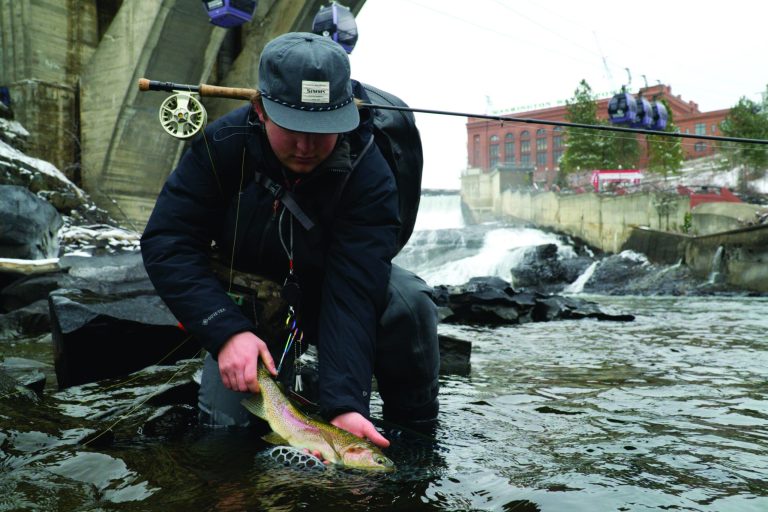
A YOUNG ANGLER lands a nice-ish trout and wants to share the photo—not only because of the fish, but because of the location: at the base of a waterfall, beneath a bridge and a gondola, in downtown Spokane, Washington.
He posts the photo and gets plenty of positive feedback. He also gets several direct messages from angry locals who call him out for hotspotting. But there are no “secret holes” in the heart of a city with a quarter of a million people. The reason few people fish that spot isn’t because no one knows about it; it’s because everyone knows about it. And what prevents more others from fishing it is secrecy, it’s the stigma of urban flyfishing.
That young angler received plenty of awkward stares as he hiked down a hill in his waders, being gawked at by people in apartments, office buildings, health clubs, and restaurants. So if that’s your “secret spot,” you aren’t looking very hard. More importantly, you’re missing the deeper purpose of preventing—or, in some cases, encouraging—modern hotspotting.
Indeed, if there’s a disappointing aspect to my friend’s post, it isn’t that he appears in the photo, it’s that he’s the only angler who appears in it. He is standing in the middle of Washington state’s second largest city, fishing a river where eighty-pound chinook salmon once swam. If such a photo generates anger, it should be because the poor kid is standing there alone. That’s not the revealing of a secret spot; that’s a conservation crisis.
In previous decades, the more a place was promoted, the more it was abused. That was the damage of hotspotting.
Nowadays, even anglers still able to retain their secrets in tucked-away streams understand that purposefully exposing these spots may be necessary to save them from privatization, resource extraction, or other commercial interests. This isn’t always the case, but the wise ones know when their stream needs more advocates not less. That’s the benefit of hotspotting.
The Spokane River does not need more anglers to “survive”. It needs more anglers to be revived. Those huge chinook are ghosts; it’s been a river limping along with just three hundred trout per mile. It is calling for angler advocates.
Some claim: “We should keep those last honey holes a secret, for the trout!” To them I say: Yes, more fish in that spot will get pressured. Some will wise up and be harder to catch, some may move up or downstream, others may even die. But the biggest risk is unchecked city development over the top of them.
The Spokane isn’t alone. Urban fisheries need help: Denver’s South Platte; the Cumberland in Nashville; the Truckee through Reno. Help promote these places, and some who travel to hammered rivers like the Madison or the Upper Delaware might consider exploring locally instead. Few cities had the foresight of Boise, with a 25-mile greenbelt along the Boise River.
I’m going to fish the Spokane, catch one native redband, and share the experience, because I want more people to give a damn about it. What’s important is understanding your local river’s needs. If it needs more active, interested advocates, then let’s not hound someone for trying to get the word out.
I started to fish the Denver South Platte regularly the past couple of years, and being a streamer junkie, find it to a be a great section of the South Platte for trout and bass. Besides catching and releasing some big browns and rainbows, I also get largemouth bass and smallmouth bass. It is also great to catch and release some nice fish, then be able to grab a drink and eats afterward at a nice restaurant walking distance from the river.