

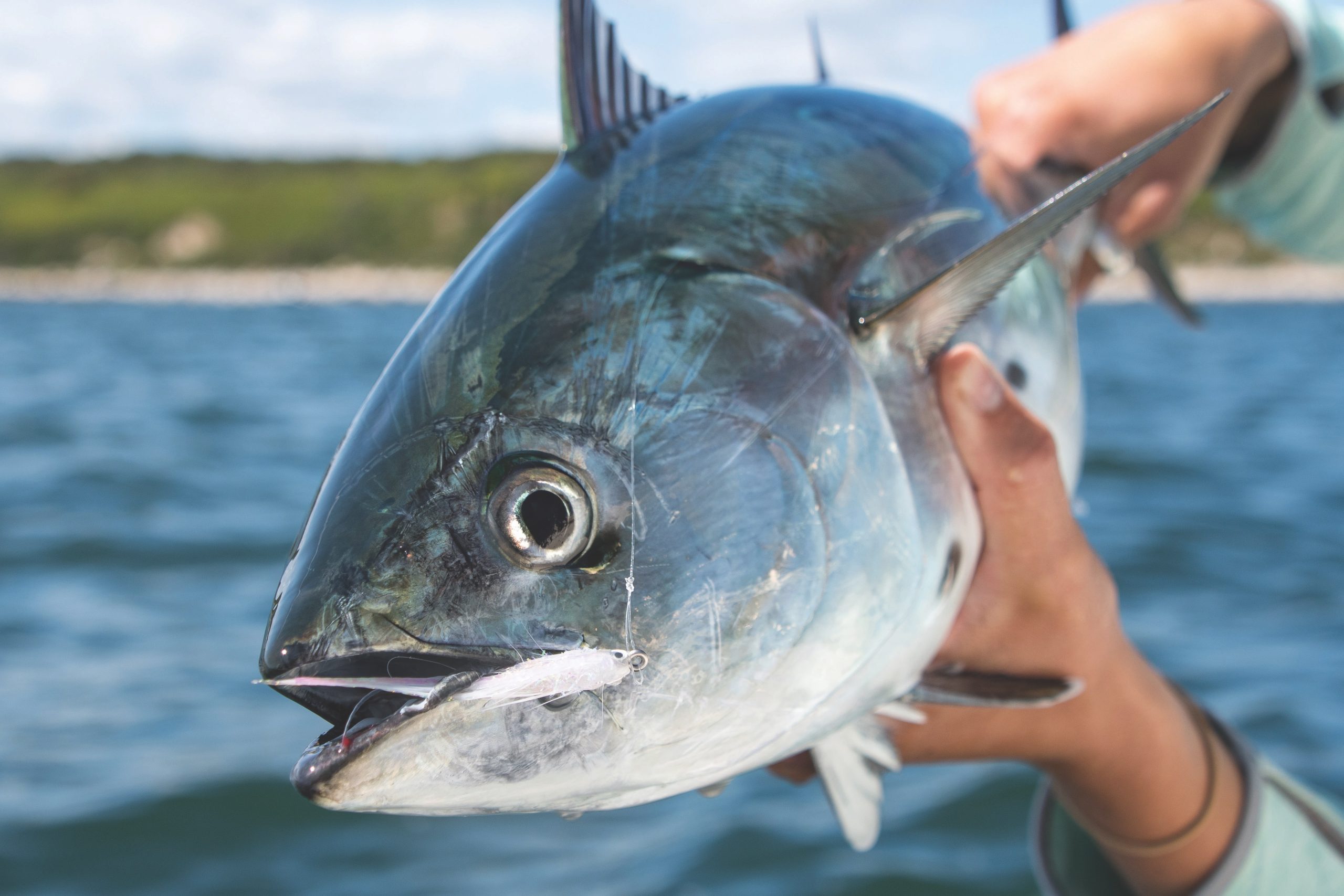
False Albies on the Fly
BY WILSON GREENE IV
THOSE WHO PREFER fall fishing typically want to partake in a peaceful practice, connecting to the water and the fish at a time with fewer jetskiers and Instagramming paddleboarders in manbuns. These anglers aim for graceful, leisurely, practical fishing. Then there are those who chase false albacore.
Every autumn, false albacore (albies, little tunny, Atlantic tuna) decimate baitfish up and down the East Coast, from Martha’s Vineyard to Cape Lookout. And for every blitzing band of albies there is a fly angler whose ass will be kicked by chasing them. Jerry Garcia once compared the Grateful Dead to licorice: “Not everybody likes licorice, but the people who like licorice really like licorice.” Albie anglers like licorice.
Finding the fish is more than half the battle. Binoculars and birds are your best friends, and hours or days can be spent scanning a horizon for exploding bait and diving gulls. You may find yourself longing to cast. Just once. But blind-casting isn’t a luxury afforded here. This is sight fishing at its most extreme.
Then you spot them—two hundred yards off starboard, three other boats synchronously inbound. For all the gracefulness rightly associated with our silly sport (tight-looped, overhand, exact casting of a size 16 Adams to risers on a slow river), there is none to be found in albie fishing. Gunning your seventeen-foot center console in three-foot breakers while preparing to cast at a pod of fish is no recipe for style or agility. Instead, you lose your footing, your hat, you curse prolifically, and you make many casts to spots where the albies just were, but now are not.
You barely manage to glide into casting distance of breaking whitewater before the fish instantly dive. Then, as you prepare to throw your size-two epoxy fly—weighing no more than a stick of Juicy Fruit—into a headwind, Joey, just in from Montauk, has already spin-casted his two-ounce metal jig from two hundred feet farther out. He’s made three prime casts before you’ve attempted your first. A moment later, probably several moments later, off your port side, there are dozens of fish, jumping, scurrying, practically colliding. They indiscriminately inhale baitfish but somehow refuse your fly.
When you do suddenly connect, it is instant violence: like having your fly line wrapped around the prop of a revving outboard. In milliseconds you’re wrestling an oversized football—the fish is a twentieth your size, yet, pound for pound, stronger than you will ever be. It slices through the water at forty miles an hour, straight down into blue and brown depths below your small craft. As you see your backing for the first time since attaching your reel, you realize the 8-weight was a bad choice: It soon doubles over the gunwale as you contemplate the manufacturer’s warranty.
Maybe you land the fish, a small consolation for your kicked ass. Dizzy, sore, hatless. Call it masochism, call it folly, who cares why. Either way, you gotta be lucky and you gotta be good.

Wilson Greene IV
