


Ode to a Dabbler
When it came to hobbies, my dad was an accomplished dabbler. He’d go all in on a hobby, whatever it was, yet inevitably he’d lose interest in it. The shelf life varied for any one of Dad’s many recreational pursuits, but it was usually a matter of months rather than years. Take running, for example. Dad got the running bug following the 1977 publication of Jim Fixx’s The Complete Book of Running. I can still picture its monochromatic jacket cover with a runner in stride wearing red running shorts, matching red running shoes, against a red background. Dad read the book and then went about buying all the necessary gear: Brooks running shoes, colorful running shorts with vented slits nearly to the waistband, close-fitting nylon tank tops, terry cloth wristbands, and a usually red bandana. That was his kit. And like so many of my dad’s avocations, there was usually one idiosyncratic item associated with the new hobby that especially stood out. Here it was Gator Gum (lemon-lime flavor), which Dad chewed before a run and claimed that it staved off dehydration. As for the actual running, Dad did put in some miles. “Got in a 10-miler this morning,” he’d say. “Got my second wind around mile six,” he’d add, or “Felt great today.” Then, several months would go by and he simply didn’t run anymore.
Instead, we’d find him in the kitchen wearing an apron. There were nearby mixing bowls, a hand-cranked sifter, and a rolling pin. James Beard’s cookbook, Beard on Bread, sat propped open on the counter dusted in flour. Dad baked multiple loaves. There was white, wheat, and sourdough. And while each new loaf was usually better than the last, it didn’t last. Rather, with little warning, Dad was soon gearing up for an extended backpacking trip on the Appalachian Trail. Colin Fletcher’s The Complete Walker served as his guidebook and represented yet another volume in Dad’s growing collection of How-To books.
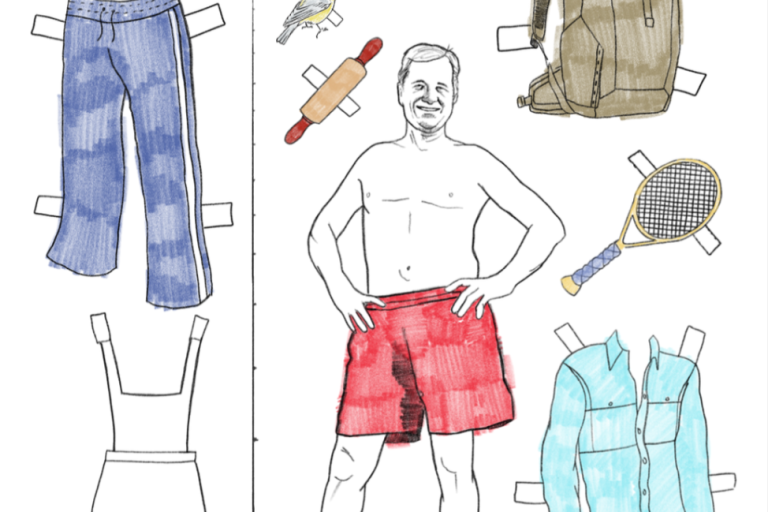
And on it went. In the 70s and 80s, Dad’s hobbies included, in no order, sailing, RVing, trap shooting, flyfishing, bird hunting, tennis, cattle ranching, elaborate coloring with felt-tipped markers, racquetball, photography, birding. And more.
For much of my adult life, I considered Dad’s inability to stick with a hobby as sad. There seemed to be a loneliness to it, as if he couldn’t find himself or his tribe. His near obsession with gear contributed to that emotion. He often seemed to enjoy the “stuff” associated with an activity more than the activity itself. And his gear was usually high-end, if not top of the line. It was important to my father to look the part, and he usually did. As such, one would assume there’d be some pressure on him to perform at a level commiserate with the equipment. Not so with Dad. He’d arrive at the club wearing a Sergio Tacchini track suit and carrying three Wilson T2000s and not once hold serve. In fact, if Dad persisted with a hobby long enough to reach a plateau, that usually meant that it was time to try something different. And by “different” I don’t mean going from a two-handed backhand to a one-handed backhand. I mean going from tennis to vegetable gardening.
In his book Outliers: The Story of Success, Malcolm Gladwell asserts that expertise is only achieved after 10,000 hours of practice. Ten thousand hours is a long time. Think about that. On average, one can earn a basic pilot’s license after about 50 to 70 hours of flying, or captain a commercial airliner after about 1,800 hours. I like to think of our commercial pilots as aviation experts, notwithstanding the fact that many of them may be flying us around without having achieved Gladwell’s “expert” threshold. To be sure, my father never achieved expert status at any activity—not by Gladwell’s yardstick or otherwise. But expertise didn’t seem to be Dad’s goal. Rather, he was a happy-go-lucky dilettante who enjoyed life and new life experiences. And nice stuff. Or perhaps, alternatively, maybe Dad never found that one thing that truly captured his imagination. Either way, I no longer think of Dad’s hobby waffling as melancholy. I now believe that he simply enjoyed variety in life and suffered little if any ill consequence by abandoning hobbies on roughly the same schedule as most of us change our oil.
I’m grateful for Dad’s dabbling because in one way or another each of his short-lived hobbies positively impacted me. As a young boy and young man (pre-college), my father would always encourage me to join him in whatever it was, continuously exposing me to new things. And he wasn’t dogmatic. If I didn’t care for running or racquetball, so be it. He didn’t push it. Rather, he would plant ideas, notions, and facts and let me decide.
Here’s an example. When I was about ten years old, he and I were walking north along the Appalachian Trail near Mount Rogers in Southwestern Virginia. It was my first real backpacking trip, an overnight. It was fall and I was carrying a simple canvas rucksack—red with dry-rotting leather straps. I’d be surprised if my “pack” weighed more than ten pounds. I was carrying an extra change of clothes, a rain poncho, and a shallow stainless-steel bowl shaped like a prospector’s pan.
Dad, on the other hand, had us covered. He was carrying a fully stuffed external frame backpack that cleared the top of his head by close to two feet. There was a tent, sleeping bags, a stove, fuel, our food, and water. It must have weighed sixty-plus pounds. He carried a knotty hiking stick, and our canteen was wool-covered with Hudson Bay-like stripes. Oddly, Dad wore tweed knickers supported by suspenders, red knee-socks, and full leather hiking boots with red laces. Almost lederhosen, this kit.
Somewhere between the trailhead and our destination for the night we stopped for a snack and a drink of water. With a fist full of gorp and his gaze toward the horizon, Dad said, “You know Mill, this is no ordinary trail. If we kept walking in this direction, we’d walk all the way to Maine, and if we turned around and walked the other way, we’d end up in Georgia. Wouldn’t even need a map! We’d just follow the white blazes.” It was a wonderfully simple way—in real time and space—to prime the imagination and curiosity of a kid trying something new for the first time. And it worked. While my father’s interest in backpacking generally and the AT specifically fell by the wayside, mine did not. What Dad gave me on that weekend in Virginia was the start of a life-long love and appreciation for long walks in the woods and a special fondness for a linear ribbon of dirt and rocks stretching north and south through fourteen eastern states. For that, I’m so grateful.
But perhaps the greatest impact Dad had on my recreational life was his ephemeral foray into flyfishing. One night in the late 70s or early 80s while sitting at our dining room table, my father almost literally ordered up the Orvis flyfishing catalogue. I wandered into the dining room as he was filling out the order form.
“What are you doing?” I asked.
“I’m ordering some fishing gear. Want to give flyfishing a try,” he said.
“What’s flyfishing?” I asked.
“It’s an old fishing technique from Scotland. It’s different than the fishing we’ve done. No worms or lures. You use flies made of feathers,” he explained.
Dad ordered up rods and reels, of course, and line, leader, and tippet. A fishing vest. Hip waders. Leather and shearling reel covers. Multiple dozens of flies. Dry, wet, and streamers. Fly boxes. And as if he couldn’t help himself, he ordered a gimmicky knot tying tool, an origami-like metal net with evil pinch points, and a Scottish tam.
The gear arrived a couple of weeks later. We went to the lake to try it all out. I sat on the dock and watched. Dad seemed frustrated. We came home and he stuffed most of his new equipment into a large canvas duffle bag and threw it into the hall closet, though he continued to wear the tam. And that was that.
Until, years later (I was in college), when I sought out that duffle bag of flyfishing gear before a summer trip to Upstate New York. My host said that there would be good flyfishing. She was right. The property was a private hunting and fishing club. There was a small creek running through it that held trout. Many of the club members were accomplished fly-fishermen and women. On one of my first afternoons, I stood on the creekbank looking the part with Dad’s almost unused equipment. And like Dad, I had little idea what to do with it. A fly reel and fly line were unfamiliar to me, I had no idea what fly to use, nor how to cast. I’d make a “cast,” create a big splash, and watch as nice fish darted back and forth, spooked and in no mood for me. I was frustrated and about to do as Dad had done and pack it all up. Maybe I’d go for a hike instead.
But there was a Fourth of July picnic later that afternoon that saved my flyfishing career. I was chatting with a club member relaying to him my earlier incompetence. Sympathetic, he pointed with his gin and tonic hand and said, “Go talk to that gentleman if you want to learn something about flyfishing. He’s the best fisherman I know.” The club member was pointing toward an older man. Trim and well dressed. With nothing to lose, I walked up to him and introduced myself. I told him that I’d like to learn how to flyfish, that I was struggling with it, and had heard that he might be able to help me. The gentleman paused a beat before he spoke to me. I felt a bit exposed standing there with my paper plate in hand and wondered if he didn’t know then and there that I had dabbler DNA running through my veins. But if there was judgment on his part, he hid it well. His name was David Hedrick, and he could not have been kinder to me. We had a nice chat, almost none of which had anything to do with fishing. He wrapped it up with, “Why don’t you come by the cabin in the morning around 9:00. My wife will make us breakfast, and then we’ll go fishing.” I thanked him and eagerly agreed.
I was up early the next morning. Excited. Nine o’clock seemed forever away. I arrived at the Hedrick cabin right on time. Mrs. Hedrick, whose first name was Betty, was making pancakes. Mr. Hedrick and I had coffee on the porch while waiting for breakfast to be ready. We then ate our pancakes. I ate too quickly and thanked Mrs. Hedrick. Her betrothed, however, had a second helping and seemed to want to linger at the table. “What are you studying?” he asked. Then, “What do you like to read?”
Thereafter, Mr. Hedrick insisted that we return to the porch and learn to tie two knots before going anywhere: a simple fisherman’s knot for attaching the fly to the tippet and a blood knot for connecting leader to tippet. Knots down and now even itchier to go, I said, “Mr. Hedrick, I’ve always heard that early morning fishing is best. Shouldn’t we get going?” Again, he paused a beat before he spoke. Then, lyrically, he said, “Our’s is a midday stream.” I’ll never forget those words. Not only was he telling me about the character of the local stream, more importantly he was telling me to slow down. Enjoy the journey. I didn’t know it then, but coffee on the porch, a conversation over pancakes, learning to tie knots, the ride to the stream, gearing up, the walk to the water, sharing a sack lunch, sitting on a rock watching a kingfisher, having a Coke or a beer back at the truck—all of it—is part of the wonderful journey that is a day with a fly rod. I am forever grateful for the groundwork that Mr. Hedrick subtly laid that day: Slow down. Enjoy the totality of the experience. In fishing and in life.
Finally, we loaded up the truck and set out for the water. Rather than fish on the tiny rill that had vexed me the day before, Mr. Hedrick treated me to the nearby Bush Kill. A beautiful eastern trout stream that’s well aerated with considerable rock structure. We walked out into the middle of the stream together, fly rods in hand. The water was about knee-deep.
“Can you cast at all?” he asked.
“Not well,” I replied.
“Not to worry,” he said.
Mr. Hedrick was a patient teacher. He went about showing me the basics of a simple cast—a ten-and-two metronome motion with very little line out. After a few practice casts, he told me to turn around and face upstream. There was a partially exposed rock in the middle of the stream about 20 feet in front of me. He said, “Make a short cast just this side of that rock.” I did, and my fly, a red humpy (I’m guessing size 12 to 14), drifted back toward me floating high on the water. “Okay, now make a cast a little to the right of the rock.” Nothing. “And now to the left of it,” he said.
Then, as if in slow motion, a beautiful brown trout gently rose to my fly and ate it. “Lift!” he said. The fish was on (and on the reel, as there was very little line out). After a short fight during which I was instructed for the first time to “keep my rod tip up,” Mr. Headrick took a few steps upstream and gently netted my first trout on fly. Joy. I couldn’t believe it. I was so happy and so appreciative of having met this man. A stranger before yesterday, whose love of the sport and gentlemanly manner inured to my benefit and became today’s good fortune. Mr. Hedrick passed away in 2010. His obituary noted that, “[t]hroughout his life he taught conservation and many people to flyfish.” I am lucky to have been one of them.
Following that eventful summer trip to New York, I’ve now pursued fish on fly over the course of decades. Through college, law school, a legal career, and in my nascent retirement. Flyfishing remains my favorite hobby. And save reading, it’s the hobby to which I’ve devoted the most time. I’m no “expert” by anyone’s definition, and I’ll never become the fisherman that Mr. Hedrick was. But I’m more than a flyfishing dabbler. For that, I owe a great debt of gratitude to my father. A tam wearing dabbler of the highest order and a true lover of life. Thank you, Dad.
I love you and I miss you.


Miller Bushong
