

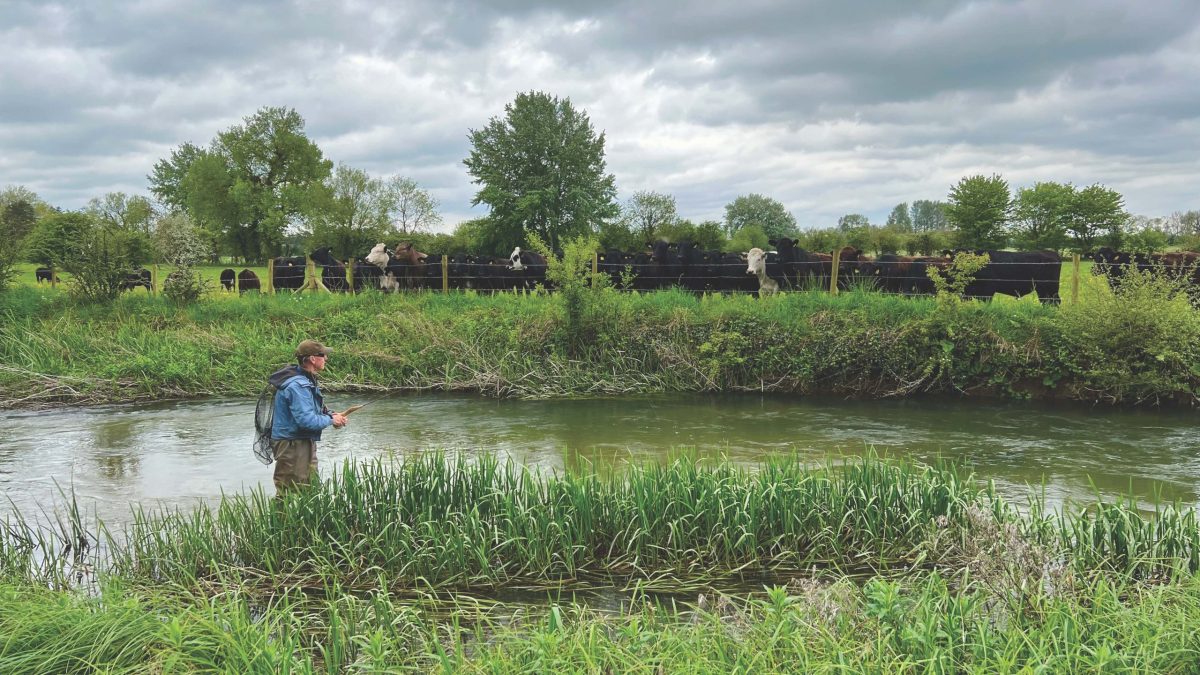
English Patience
In May, what must a mayfly think? Does it wait calmly for the tender moment of copulation, or itch to get on with it? I pondered these mysteries, more pressing than they might appear, on a river in the Cotswolds, a part of England touted for antique shops more than trout.
The River Windrush was roily, no mayfly in sight. Rain had fallen for weeks, reported my host, Charlie Shields, peering down from an old stone bridge. Charlie, though American, has a cottage here, partly for fishing. He’d soaked in that rain those weeks, but I’d just now arrived from Florida. For years I’d flown over to hit the green drake hatch—what the experts hereabouts call “duffer’s fortnight”—but managed always to miss it. So here I was again, too early.
We set out anyway through a spongy meadow of buttercups, heading for a pool we knew. Cows mooed and calves bawled. The river weaved along the meadow’s edge, in and out of sparse woods. Charlie belonged to an angling club with rights to this stretch. To our dismay, then, we came upon a wire fence hooked to a huge battery. The clamp appeared to be insulated. Charlie grabbed it, the battery then routing through his person enough voltage to knock him nearly on his butt.
Finding a way around, we pushed on to the pool. Charlie was just starting to cast a pheasant tail when the water abruptly blew up. From the undergrowth along the bank, a child poked his head out, looking like a juvenile Mick Jagger. In his fist was a second rock, ready to lob. The woman with him, mother or governess, clutched an armload more. Activists, maybe. Save the trout from foreign louts. A viable point.
Now fugitives, we fled around a bend to a glide in a kind of leafy arcade. Under the boughs a fish was rising. The confines were an invite to casting disaster, and Charlie graciously insisted I give it a go.
Cottony seeds were on the water, but no hatch. With a deer-hair caddis I chopped a cast under the trees and managed a short drift. The fish boiled but didn’t take. Several more casts and the caddis stuck on a limb. I tied on a terrestrial, a fat thing like a picnic ant. The fish was cruising now, rising here and there. Not, though, to the ant. It struck me then that I had crossed a whole ocean for this. I opened a box and out popped a White Wulff, a big dog-chew of a fly.
On the first drift the Wulff drew a splashy rise and hookup.
A foot-long fish sloshed away, its shoulders awash. The fight was short, the shoulders plated with large scales. I’d never before caught a European chub, so there was that—a new species. In England they are classed as a coarse fish, as opposed to trout and salmon. I was a coarse fisherman. So be it.
Off, then, to the pub down the flowered lane from the bridge. If the tipplers there suspected me of being a toff, a highfalutin trout fisherman, I would proudly produce the photo of the chub. No, I wouldn’t. In shooting it, I’d dropped my phone in the fathomless murk of the pool. Where it sank in the roots, a little spasm of gas bubbled back up.
I’d gotten off on the wrong foot a few days earlier, upon first landing in England. At Heathrow I trundled an enormous suitcase onto the train to London—the wrong one, it turned out. The ticket seller had waved me into a hell of tiled tunnels to the platform, where I boarded a local instead of the express. At stop after stop more passengers piled on, store clerks and students who ogled my suitcase as though it might hold explosives.
Paddington Station came none too soon. I found my hotel and hung up my suit, which I would need the next day, then walked in the twilight a few blocks to Hyde Park. There in the gut of the city was salve for the claustrophobic eight-hour flight and jittery train ride. Pairs of Londoners strolled the broad lawns beneath cozy old oaks. Half a mile in, I came to the Serpentine, a ribbon of lake curving toward Kensington Palace. On the shore a flock of swans parted to let me pass. The waters rippled in lamp light. Surely they held fish, the coarse sort. I wanted a rod.
Behind us now on the Windrush were the rock-tossing imp, the zapping fence, the cheeky chub. For a new fishing day I donned a cap bearing the logo of a local feed store, which made me feel part of the country. Charlie and I rode to the river feeling the aftereffects of Toad-in-the-Hole, a fine pub dish we’d downed the night before. Ours was made with Old Spot, a tasty Gloucestershire breed of pig. We’re in the country, the country’s in us.
A trout has no clue what country it lives in, or on which sceptered isle, as Shakespeare called Britain. Its country could be a patch of ranunculus—an aquatic plant here—below which it spins in an eddy and from which it sprints out to feed, either sparingly or like an Old Spot pig.
Piggy or picky, all feeders were fine by us. Maybe the mayflies would get going. In London I’d had a text from a Montana friend saying he’d seen a mayfly in a hardware store in Missoula, half a mile from the Clark Fork. The flies were less flighty here on the River Coln, a classic English limestone. Brimful yet clear, it swirled through a garden of ranunculus and under a gated footbridge, no hatch yet in progress.
In years past we’d fumbled along this stretch with the phenomenal guide Mark Purvis, who was dogwalking us again today. Mark knows every rock and log in the river, many of which he put there himself. He serves as secretary of the Cotswold Fly Fishers, who not only fish but get out with saw and shovel, grubbing in the banks to better the trout habitat.
Stalking through the meadow, we spotted a row of rises in the glide at the head of a pool—drops from the eaves of heaven, let’s say. From my knees, I fired out two casts with a CDC & Elk that fell wide. The third drifted neatly down on a tangent ending in the trout. Against a backdrop of yellow irises the fish raced around the pool and jumped, a sleek brown, then rolled over finally in Mark’s net with what seemed a put-upon air.
A better day already, fragrant and fluent. A rakish bird of prey, a red kite, tilted over the windless meadow without moving a wing. Deft. We moved up to a slender stretch bordered by bulrushes and a few pear trees in bloom. The current was quick, and from the bulrushes, calf-deep in muck, I made a roll cast to a riser. Pear petals drifted down with the CDC & Elk, one of Mark’s own ties. No take. I switched to an olive Sparkle Dun, also Mark’s, drawing a rise, which
I missed.
In this part of the Coln most of the browns are wild. Sometimes in the currents we’d spot a dusky form on the bottom, nosed into a shallow dip behind a stone or log. These, Mark said, were hatchery fish, newly stocked, that hadn’t yet figured out the real world and found themselves a proper lie. Whereas the trout we were casting to, native to the river, knew the arena.
At Charlie’s urging and mine, Mark had brought along his rod. In life we figure it’s a major navigational error to tramp around with a first-rate angler on his own waters and not see how he casts, and finesses a fish. The rod was new, made for Mark by a builder on the English seacoast. Bamboo, seven-foot, four-weight. In fact he hadn’t fished it yet; this would be its premiere.
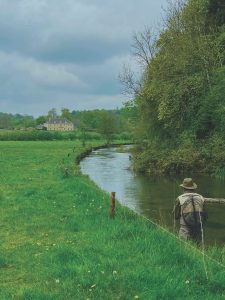 In the ranunculus, a hatch was happening. Mark went to work on a rising fish. Hawklike, he metered out a short cast, maybe twenty feet. Then several more, casts made mostly with the wrist, more rotary than back and forth, lower to the rear, higher forward, one false cast at most. He stuck with a single fly, whatever it was, and on the ninth or tenth drift he stuck the trout: wary but suckered. All magical, first cast to last, bend of bamboo, fly line flowing in honeyed spring light.
The trout tried to dig into the vegetation, a trait of wild fish. The hatchery sort, Mark said, didn’t know enough to try this. Rod jogging, he slid the fish finally into the net and released it. “That rod’s no longer a virgin,” noted Charlie. Mark beamed.
At ease on a folding seat he’d lugged along, Charlie was a prince of sporting etiquette, insisting that Mark and I do all the fishing today. This chivalry came not from any deficit of competitive spirit. In his day he was a professional race-car driver, winning forty-four straight events before crashing and crushing a leg. The painful effects persist, not that he trots them out as excuses when failing to foil a fish he’s after.
We stroll on upstream. On our side the bank is a low stone wall with the meadow spilling over it, straggles of nettle and blackberry. The bank opposite is a wood, with bright bluebells in bloom.
With the trout and me it’s mostly a staring contest. In the lane of current by the wall a fish shows, and I get a drift or two before twirling the fly around a stem of overhanging nettle. Moving on all fours Mark flicks it loose. A few more drifts but the fish won’t have it.
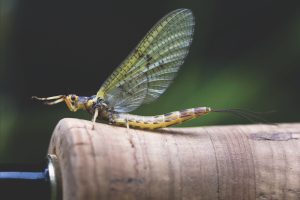
Soon, though, a big mayfly flutters up: a green drake, Ephemera danica. To us the Latin’s allowable, since Charlie and I took high-school Latin classes together. Anyway, this is the one we’ve been looking for. Though today it won’t hatch in any numbers, just a scatter in the afternoon, it’s encouraging to see it at last.
I catch three more browns, as does Mark. Charlie, resolute in his support role, totes the bag of refreshments and guards it, he says, from any gypsies or Labourites who might be afoot.
Charlie’s sporting gallantry likely traces to the race track. At the Sebring Raceway in Florida he first met the English driver Stirling Moss, widely regarded as the greatest Formula I racer, and all-round racer, of all time. They became close friends and later a team, in European road racing. They were two of a kind in sportsmanship. In a famed instance, Moss finished first in a Formula I race, then argued successfully for the reinstatement of a rival who’d been disqualified—thus losing the world championship to him by a single point.
Don’t worry, growls Charlie. He’ll fish his butt off when we’re out again with Mark next week. Today I’d better take advantage.
At the end of the meadow, a palatial old country house poses on a grassy rise, fronted by some cattle. Heavy glass doors stand open and hushed voices filter out to the terrace, on topics not detectable: a rewritten will, perhaps, or rumors of divorce. Maybe, romantically, someone’s been murdered. Near the house a low dam backs up a pool for irrigation. It’s wadable. On the still water under some hawthorn, Mark spots a swirl.
Where I wade in, it’s hip deep and hard to see the bottom. I work out a few yards of line and wait. The fish puckers up, sucks something down. My cast is jittery but the fish inhales going away, gets itself hooked, then bucks around under the hawthorn and jumps. Strangely, it’s not a brown but a rainbow, sixteen inches. Where did that come from? Its kind aren’t encouraged here but it’s too fine a fish to kill.
Back it goes.
So, the suit. The day after taking the wrong train to London, I met Charlie in front of Westminster Abbey. Dawn’s indigo lingered in the streets, as did the scent of the Thames, a river not known, in its passage through the city, for any hatch of mayflies. In front of the abbey’s Gothic facade rested a half dozen race cars behind velvet ropes. In my suit I stood looking bewildered while Charlie shot a photo for my wife. I didn’t yet see what any of this had to do with fishing, but that would dawn on me later in the day.
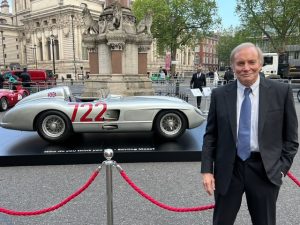 All six cars were raced by Charlie’s pal Stirling Moss. Motor racing is immensely popular in Britain, and Moss was knighted, a national hero. He’s the only real-life person ever to appear in the James Bond fiction of Ian Fleming. Cops stopping speeders will ask wearily, “Who do you think you are, Stirling Moss?” Of the cars here, the most famous is the Mercedes 300SLR, in which Moss clocked the fastest time ever in the Mille Miglia, a thousand-mile race in Italy. The Mercedes museum in Germany flew it over for the occasion today.
We waved our invitations and went in the abbey, empty at this hour. I found my assigned seat near the altar. Sir Stirling Moss died in 2020, a nation’s lament and Charlie’s. In those pandemic days, no service was held. Today it would happen at last, with 2,200 invited.
I wondered how many casts it would take to cover this place. The central aisle seemed to stretch forever, from the altar to the crypt of the Unknown Warrior. The crowd filed in, lengthily pedigreed, out of my league. In due time came Prince Edward, the Duke of Kent, representing the King, who was being treated for cancer. The Duke, nearing ninety, tapped a cane along the aisle like a man with a wading staff testing a streambed.
Mortality. The term applies, alas, not only to losses of trout after release. Fish while you can, fast like a racer, but slow.
With a riff of Bach the service began. Charlie leapt to the lectern and read the biblical passage beginning, “Let us now praise famous men.” Moss’s race helmet was laid on the altar—a polo helmet, actually, the sort of primitive kit that made racing so dangerous in his day.
The great driver Jackie Stewart delivered the eulogy. The dean of the abbey intoned a prayer citing Moss’s own words, a kind of credo: “Movement is tranquility.”
Whoa, hold it. Was that about racing, or flyfishing? It could work either way, couldn’t it? Moss wasn’t much of an angler. He’d caught a billfish or two, but that’s closer to cage fighting than flyfishing. The prayer went on without me.
The service played out and the pipe organ rumbled an old hymn by the poet William Blake, commending not only God but “England’s green and pleasant land.” No mention of rivers, but you know they’re in there.
In the dew-bright spring morning we start out downstream. Not fishing yet, just walking the meadow, watching the water, occasionally scanning a pool for a trout’s nose poking up.
No nose. From a bank of nest holes a horde of swallows flits past, searching for insects. We feel it. Soon, something moves, small and reddish, farther down. Mark spots it first. A stoat, kin to a weasel, stopping and going in the fresh grass, looking and listening with its nose. The wind’s in our favor and the creature eases within a few feet of us. Its whiskers catch the low sunlight. A bloody predator, like us. Then our scent finds it, and it folds and runs, flowing away along the bank.
With that, the day’s made. We turn upstream, where a fish rises in fast water by some bulrush. It’s mine to mess up or not. Charlie’s not with us after all, needing to deal with legal issues in the village where he has a cottage. A local swindler has sold the same parking spaces to several people, then fled to Brazil with his exotic-dancer wife.
Luck or whatever is with me. The currents swallow the rises as fast as they form, but the first cast unfurls and the fish is on, like that. We’re back on the Windrush, but a stretch I haven’t fished. No country house. The Sticks. Fish in the net.
We move along, and the mayflies start to pop. In short order we score three trout that soar up to nail Mark’s dupes of a green drake dun. Then he hooks another that gets traction between the bank and an island, charging up and down the slot for ten minutes, the bamboo doubled over, so I’m thinking a big cannibal brown. The fourteen-inch fish that ensues turns out to have twisted the tippet around its tail.
By then it’s midafternoon, one of those moments in fishing when all seems in amiable sync—the water, the weather, the trout. We wade up farther, to a pocket of water a couple feet square, glassy as a vanity mirror. Above it lies a knot of bulrush, what Americans would call a cattail. Below it, a slim riffle that falls away fast. On the glassy pocket a fish makes a dimple. I stand in the riffle, a few loops of line drooling from my mouth. The fly needs to hit the spot, not overshoot to the bulrushes, with enough slack so the riffle doesn’t yank it away.
A forty-foot shot at most, not hard, but when the line’s in the air with loose gusts wagging it, the target shrinks to a shard. No matter. The instant the fly plinks down, it’s gone. The trout darts to the reeds and I let it run. Then it plows on through to the pool above, and we wade up with it. Mark nets the fish, but not before it makes a few quick rounds of the pool. You feel you’re in a painting, a bit of a blur. The okay cast, the flurry that followed. Movement is tranquility.
The day wanes, the light warms toward evening. Now up and down the river the mayflies are drifting en masse, fluttering up. So many seasons of waiting for this, so many long weary nights stuffed in Airbus seats, listening to blues tunes. And here’s what happens: the fish quit.
Our casts go unanswered. At most, a picky trout makes a half-hearted pass. We’d gladly settle for a hungry chub. Besides the duns there are spinners now for dessert, dancing in the brambles. We take a photo of a damselfly perched on a nettle gobbling a spinner. The closeup is grisly. Last week on a lake, Charlie caught a sixteen-inch rainbow and pitched it on the bank for dinner; a rook came along, related to our crow, and scooped out its eyes like oysters. In nature everyone eats like a horse, except supermodels and trout.
In truth I only know about trout. And maybe not much, in mayfly season. For a day they did their mating dance. In the morning I fly back to Florida and work, no wiser.

Parker Bauer
