

Measure Up
By Dave Hughes
I wish I had a photo of that moment. I don’t. You’ll not be able to see it. I’ll not be able to forget it.
It was on a favorite smallish lake in Oregon’s Blue Mountains. With summer approaching, the weather had broken toward mild. Snowbanks melted into rivulets and rushed down the forested mountains toward the lake. Sunshine warmed the water. Damselfly nymphs began their patient migration toward shore for emergence, though not many adults dared risk their delicate wings against the mountain winds yet.
This sudden availability of nymphal nutrition interested an abundance of rainbows twelve to twenty inches long, turning them hungry and feisty and fat. The annual planting of catchable trout for the tourists hadn’t happened yet, so there were no recently stocked trout around to distract from the holdovers.
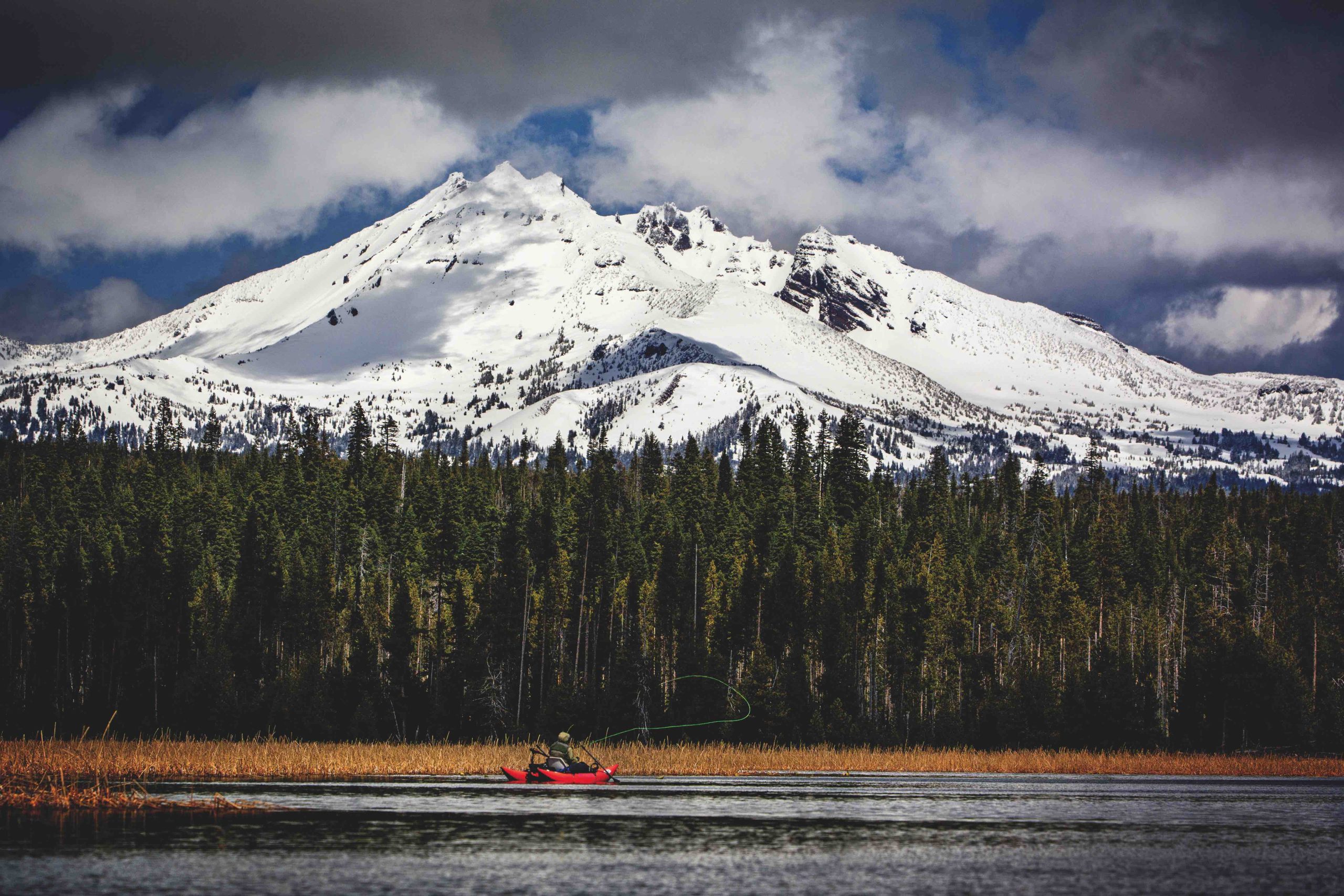
I’d bought a new inflatable to replace my worn-out pontoon boat. It was called a Cruzer—a float tube with oars—not its maiden voyage, but still in something of a test-drive phase. So far, the new floater seemed almost ideal on small stillwaters, ponds especially, but also on lakes less than twenty acres, the size I embarked upon that promising morning.
Not long after launching—rowing away at first, then securing the oars and finning off more slowly—I was towing a small Woolly Bugger trailed by a Zebra Midge on an exploratory circuit of the lake, when I discovered a major flaw in my tiny new boat: A measuring strip across the casting apron marked with way too many inches.
My rod popped, a trout leaped in the distance, and it was obvious at once that this was a coveted twenty-incher. I played the fish long and gingerly, eventually getting it close enough to see that it had eaten the bigger fly, attached to stout 3x tippet. So, I put the butt into it, got its head up, and soon slid it slowly to the net. But when I hoisted that fish onto the mesh measuring-stick stretched across my bow, it destroyed one of my most treasured illusions in flyfishing. Turns out, twenty-inch trout are only eighteen inches long. They probably always have been.
I stopped fishing for a while so I could work on the faulty casting apron, soon discovering a way to turn it upside down and get that ruler out of my sight. But it was too late; I couldn’t get it out of my mind. The rest of the trout I caught that morning and into early afternoon were all slightly diminished. It’s clearly going to be a problem for the rest of my life.
I had a late lunch on shore, a pleasurable piss, and an extended meditation, also known as a nap, all warmed by the feeble spring sun. Fishing had been satisfying, even if the trout were a bit smaller than they used to be. I was in no hurry to launch again but finally prodded myself back into the tube. While I’d been relaxing, a mild breeze had grown into a mountain wind, blowing in a few high clouds. That wasn’t a problem; I was dressed for it. I rowed and kicked, trolling and casting toward evening, catching more than a few of those downsized trout.
Well past dinner time, after the light had faded, I noticed a few small grains, the size and color of white rice, bouncing across the upside-down casting apron. It took a few moments before I realized they were pebbles of snow, akin to but lighter than hail. I looked up to see what I’d been too busy to notice: The sky had turned black up there.
I returned to fishing, which had been excellent, making it nearly impossible to quit no matter the declining weather. Nevertheless, I began heading in the direction of where I’d parked my rig. After netting and releasing what should have been a final nice trout, I had a glance toward the shore and was unable to see it, thanks to falling snow and nearing nightfall. As I crept closer toward shore, I eventually brought it and my pickup into sight.
Feeling safer, I continued lofting my line toward the near- black sky, letting the wind turn me into a distance caster. I kept my flies in the water, and an occasional trout on the line, as I kicked toward the end.
A man and woman emerged from their cabin and walked down to the shore to make sure their dock was secure in the abrupt storm. The lady saw me and called out in obvious irony, “You look like you’re having fun out there.”
“Fun’s not the word I’d use,” I called back, but the wind that drove her words out to me whipped mine straight away from her.
They retreated inside. I fished on. Then came the picture that I couldn’t take but cannot unsee: A gust struck, blowing the thick, shore-obscuring snow exactly parallel to the surface of the lake for about a minute, then paused a few seconds, then abruptly reversed itself, blowing the snow precisely parallel to the lake in exactly the opposite direction. In the midst of the swirl—and reversal of the wind-driven snow—a trout took my fly with a brutal thud, leaped into that frantic maelstrom, then tipped over and returned to the water, an awkward black silhouette against the white snow.
The fish yanked a long length of line from my reel and was hooked on the midge and its 4x tippet. I was cautious and released it without taking it out of the water, careful not to get that fish anywhere near the casting apron with its unforgiving ruler.






My rule: don’t measure or photograph your fish and they can be as big as you like.