

Seven
ONE
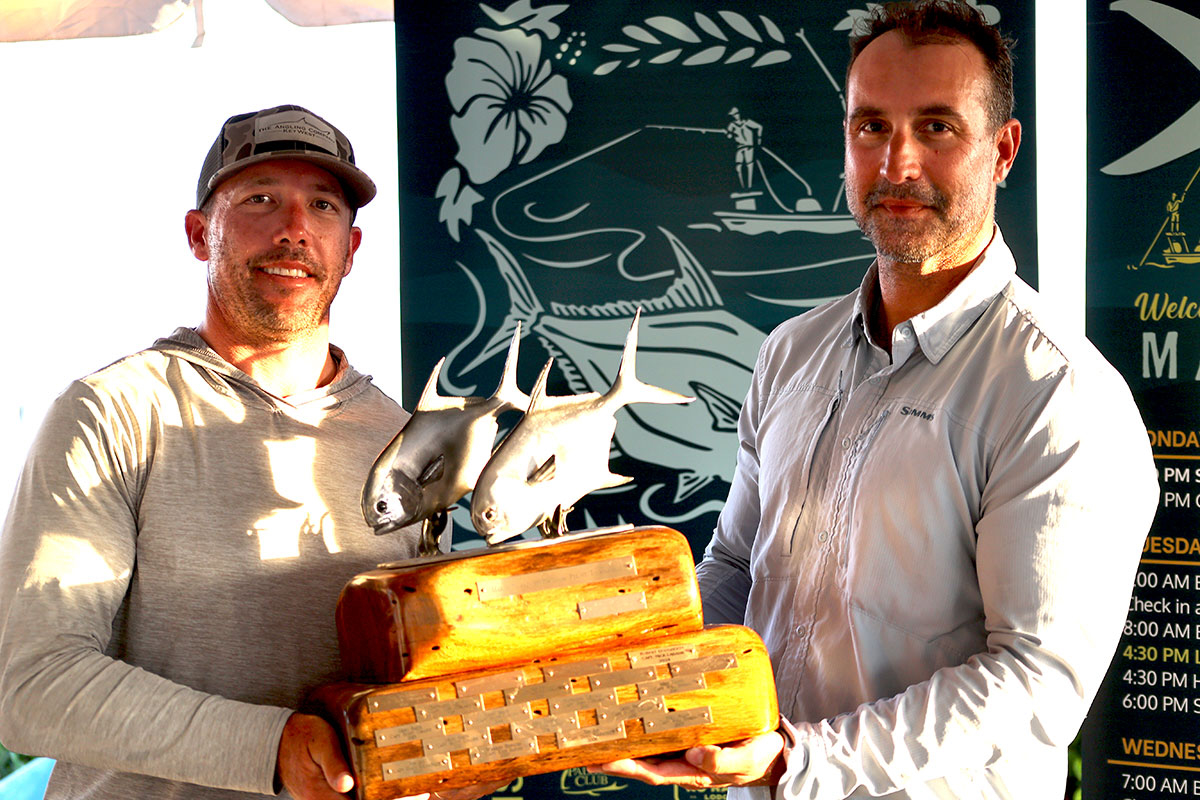
Daybreak on the last day of the March Merkin permit tournament in Key West. The sky is virtually cloudless, the winds light. It’s not what Nathaniel Linville and Ian Slater had in mind. “We like it when it’s tough out,” Linville says. In 2024, he and Slater had won the Gold Cup tarpon tournament in horrific conditions. “Our strength is outlasting and outworking everyone else when it’s like that.”
But today is the opposite, and Linville and Slater are in a deep hole to begin with, in fourth place, and well behind the leaders, David Mangum and Greg Dini, the duo that had rather handily won the tournament the year before.
At 11:18 AM, Linville and Slater catch their first permit.
Moments later, Linville hooks another permit but loses it.
TWO, THREE, FOUR, FIVE
Linville and Slater met each other in 2014 when Slater began working at The Angling Company, Linville’s Key West fly shop. Slater had just completed his once-promising professional hockey career, one that had been cut short by injuries. He’d poured that kinetic and psychic energy into learning the Keys flats as a guide. Soon, he and Linville began to fish together.
The duo is alike in some ways. Both are into physical fitness. (Linville is a weightlifter, Slater does CrossFit.) Both love to compete and have an insatiable drive to get better, to “win every day on the flats,” as Slater puts it. Both also believe that tournaments, though frowned upon by some, serve a greater purpose: innovation. “We have tournaments to thank for Chittum Skiffs, the worm fly and the Toad, two-handed stripping for tarpon and the Strong-Arm Merkin, among other things,” says Linville.
They are also different. Slater says he learned everything from sports, from leaving home in the eighth grade to pursue his hockey dreams, which eventually took him to NHL farm teams in Cedar Rapids and upstate New York. He likes to quote Nick Saban. He learns by taking things head-on. “If it isn’t hurting me then I don’t know if I truly love it,” he says. On the boat, he likes to keep the conversation focused on the fishing.
Linville, on the other hand, likes boat conversations that are “out there.” He detests spectator sports and wouldn’t know Nick Saban from Nick Cave. Linville absorbs pain well but doesn’t seek it out. He’s cerebral and analytical, scientific in his method. “It’s what makes us work,” says Slater. “Hard work meets smart work.”
Linville and Slater had not done much permit fishing prior to the tournament, just a handful of days here and there in the months leading up to it, focusing more on the tarpon tournaments. They had no plans to fish the 2026 Merkin. “Then I heard Steve [Huff] and Carl [Hiaasen] were fishing it,” says Linville. “They’re good buddies of mine so I thought, ‘why not?’”
At 1:15, Linville catches another permit. He then proceeds to catch three more in the next two-and-a-half hours. “I remember that at one point I started talking about watches, something I like to do, but a conversation Ian usually hates,” says Linville. “And he was like, ‘tell me more.’ He was suspiciously interested, like he didn’t want to mess with what was going on.”
SIX
It now begins to feel real, possible. But the duo has a slight problem. “It felt like we were hallucinating,” says Slater. “We lost count of how many fish we’d caught, so Nat had to sit down and go through the times to confirm. But even after he did, I was like, ‘are we out of our tree?’”
Being in the zone, in the trance of instinct, will do that to you. “As a competitor, you dream of things happening a certain way,” says Linville. “It’s fun to think about but that’s usually where those things stay, in your brain.”
They hit the end of the flat at 4:05. “Lines out” is at 4:30. Slater maneuvers them back up to the top. Linville catches another permit at 4:13.
SEVEN
The fighting and landing of that fish takes them off the flat. Slater spots a school far away and, instead of using the motor and potentially spooking them, he begins to pole aggressively after them. “That’s where Ian takes it to another level, why he’s such a towering talent,” says Linville. “Most people would say those fish were out of range, and they were. But not for him.”
With exactly 32 seconds to go in the tournament, Linville hooks his seventh and final permit. After it’s released, they start back for the dock. Linville sees a text from his wife, Kat Vallilee, who happens to be the 2023 winner of the event. She wants to know how he did. Linville struggles with what and how much to say. Finally, he settles on something.
“7,” is all he writes.
Linville and Slater talk on the ride back. “I will never be confident of a win,” says Linville, who has had his share of heartbreaking last days in tournaments. “The problem is that the better you do, the greater the likelihood that others did well, too.”
But they also have another discussion. “We said that no matter what happens at that scorer’s table, let’s not lose sight of what we saw and did, that this was one of the most memorable days of fishing we’ll ever have,” says Slater.
In the end, they needn’t have worried. They lap the field, with more than double the number of fish than the second-place finishers (Mangum and Dini).
It’s Linville’s fourth Merkin win, to go along with one title each in the Del Brown and the Gold Cup. The performance will go down, along with Andy Mill’s five-tarpon comeback in the 2003 Gold Cup, as the most impressive final day in a major flats tournament. It’s the angling equivalent of Johnny Miller’s final round 63 at the 1973 U.S. Open at Oakmont, which propelled him to a win from six strokes down over the likes of Arnold Palmer, Jack Nicklaus and Gary Player, or Greg Lemond’s last day time trial in the 1989 Tour De France, when he overcame a believed-to-be insurmountable 50-second deficit to the French cycling legend, Laurent Fignon.
According to Linville, it will also be his last Merkin. He says he’ll now focus on tarpon tournaments and his new online casting academy. “I’m out.”
Slater believes he’s telling the truth, for good reason. “He’s got nothing left to prove.”



Monte Burke
MONTE BURKE is the author of Saban: The Making of a Coach, andSowbelly: The Obsessive Quest for the World-Record Largemouth Bass.He's currently working on a tarpon book.